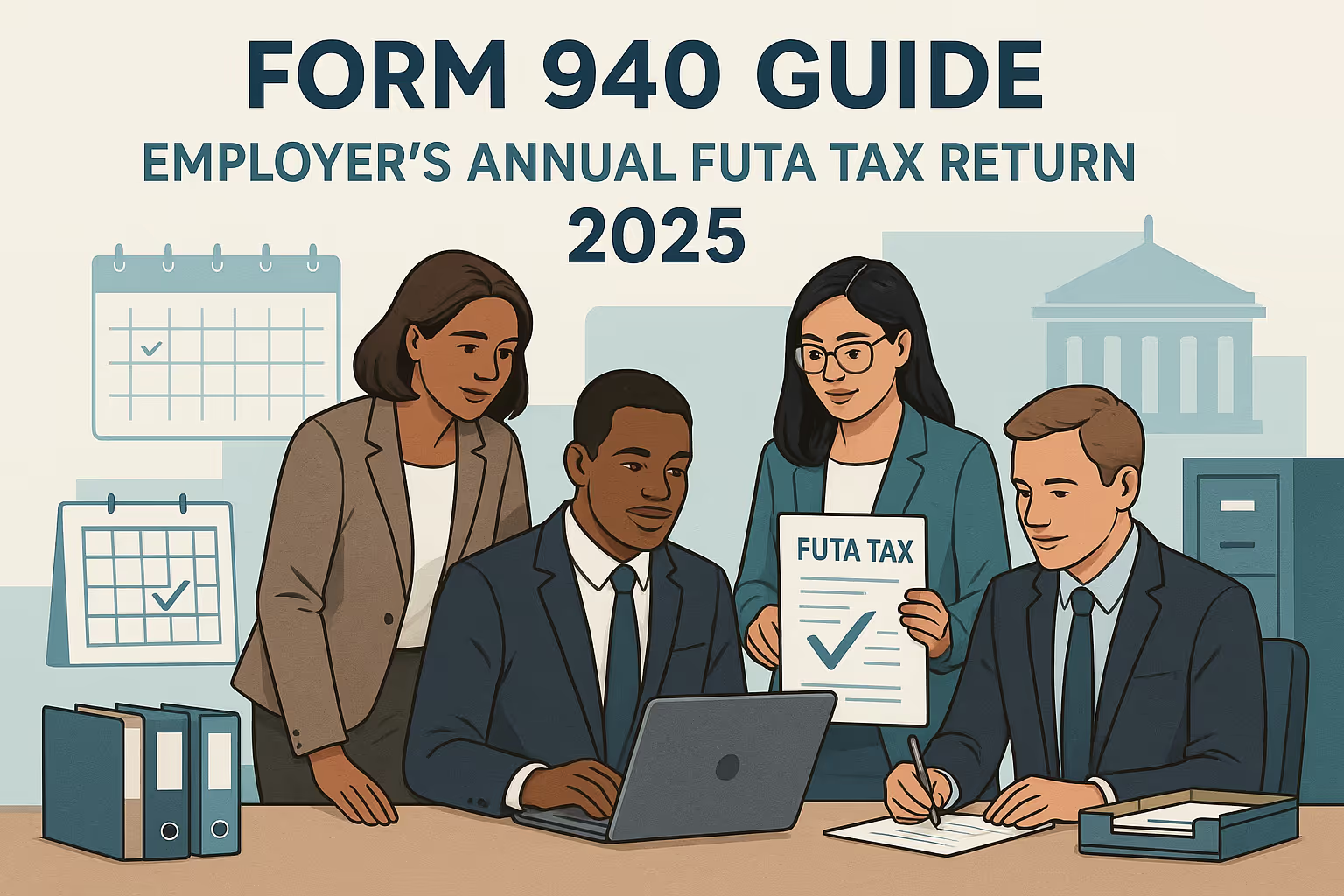


Download and year check: The download on this page is Form 940 for 2025. To correct a different year, use that year’s Form 940 and check box a, “Amended return.” There is no separate Form 940-X. Use the IRS prior-year archive for earlier forms and review the Form 940 amendment instructions.
Employers across the United States must comply with the Federal Unemployment Tax Act, which funds unemployment compensation programs administered by the federal government. Each year, most employers must file the Employer's Annual Federal Unemployment tax form, also known as IRS Form 940. This annual tax form reports the total wages paid, the taxable wages, and any FUTA-exempt payments to calculate the correct FUTA tax liability.
Mistakes in reporting can occur for many reasons. Misclassifying one or more employees, incorrectly applying state adjustments for credit reduction, or overstating total payments can all lead to inaccurate filings. Employers who pay FUTA tax late or submit the wrong unemployment taxes face interest charges, penalties, or additional tax liability. Small business employers with at least one employee must comply with federal law and maintain accurate payroll tax records.
Unlike other payroll tax corrections, there is no separate 940-X form. Businesses must file the same IRS Form 940 with the amended return box checked to make changes. Filing Form 940 accurately ensures that FUTA wages, cash wages, and employee payments are recorded properly. Whether the filer is a multi-state employer, a successor employer, or a company with temporary employees, understanding these requirements helps avoid penalties, maintain compliance, and protect operations for the entire calendar year.
When You Need to File an Amended Form 940
In several common situations, filing an amended Employer's Annual Federal Unemployment return is necessary. Knowing when corrections are required is essential for complying with federal unemployment tax obligations.
Common Scenarios Requiring Amendment
- Wage calculation errors: Incorrect reporting of wages paid changes FUTA tax liability, creating inaccurate totals for both annual tax form filings and payments.
- State unemployment tax mistakes: Errors in credits for state unemployment taxes lead to a higher or lower net tax rate than required.
- Employee classification issues: Misclassifying eligible workers or treating independent contractors as employees can alter unemployment taxes and FUTA wages.
- Credit reduction adjustments: Employers in credit reduction states must update calculations when a higher FUTA tax applies under federal unemployment tax rules.
- Mathematical mistakes: Calculation errors inflate or reduce total payments, affecting the accuracy of the FUTA tax return.
- State rate changes: Retroactive state unemployment experience rate adjustments may require updated FUTA payments and corrections on the tax form.
Identifying Errors Early
Employers should not wait for the IRS to send a notice. Regular payroll tax reviews, reconciliation with state unemployment records, and proper monitoring of employee payments help identify errors early. Prompt discovery makes it easier to file an amended return and avoid penalties before interest charges accumulate.
Step-by-Step Instructions
Correcting errors requires a structured approach. Each step ensures accuracy and compliance with federal unemployment tax regulations.
Step 1: Obtain the Correct Form
Use the Form 940 for the tax year you are correcting, even if filing during a later calendar year. Confirm the business name, employer identification number, and mailing address exactly as previously reported. Review the annual tax form instructions on the IRS website to verify current FUTA tax rate rules and credit reduction requirements.
Step 2: Mark the Amended Return Box
Check the box labeled "Amended return" at the top of the form so the Internal Revenue Service processes your filing as a correction. Enter the correct calendar year, business details, and signature. This designation separates adjustments from an original federal unemployment tax return and helps avoid penalties for duplicate filings or misrouted correspondence.
Step 3: Complete All Required Lines
Complete every relevant line using corrected amounts for wages paid, taxable wages, FUTA exempt payments, and state unemployment taxes. Recompute Schedule A if operating in credit reduction states. Ensure total FUTA tax aligns with the FUTA tax rate and rules under the Federal Unemployment Tax Act.
Step 4: Calculate Net Tax Changes
Determine whether the corrections create additional tax liability or a refund. Calculate interest from the original due date and plan prompt tax payments if tax is owed. If overpaid, choose a refund or apply the overpayment to your next return. Keep workpapers showing how the total FUTA tax changed and why amounts differ.
Step 5: Prepare Supporting Documentation
Attach a concise statement explaining each change, referencing payroll records, state unemployment confirmations, and any IRS notices. Identify affected lines, describe the error, and show the corrected computation. Include documents supporting taxable wages, employee payments, and cash wages. Strong documentation shortens reviews and demonstrates good-faith compliance with federal unemployment tax requirements.
Step 6: Choose Filing Method
Submit the amended return electronically through approved software or mail a paper filing to the correct address. If mailing, use certified mail and send the amended return to the “Without a payment” address in the Form 940 instructions, even if a payment is included. Retain copies of the tax return, forms, and receipts to align with record-retention guidance on the IRS website.
Where to Obtain Official Forms and Instructions
Employers must use reliable resources to ensure accuracy when completing or amending FUTA tax filings. Transitioning to official sources prevents errors that could lead to rejected filings.
IRS Official Sources
- IRS Form 940: The official tax form required for the Employer's Annual Federal Unemployment return is always available through the IRS website.
- Publication 15: This guide provides detailed instructions on payroll tax obligations, taxable wages, and FUTA exempt payments for small business employers.
- Form 940 Instructions: Annual instructions explain due dates, credit reduction rules, and filing procedures to avoid penalties.
- Draft Forms: Preview versions help employers anticipate changes, but should never be filed since they are not valid under federal law.
University and Educational Resources
- Academic references: Accredited universities often publish employment tax guidance that aligns with official Internal Revenue Service publications.
- Historical archives: Educational institutions maintain prior tax form versions that are useful for multi-state employer corrections or successor employer obligations.
Avoiding Unreliable Sources
- Third-party risks: Many non-official websites provide outdated or incorrect FUTA tax return instructions. Using these can create additional tax liability or penalties.
- Verification check: Always confirm information against official IRS website pages before making tax payments or filing amendments.
Understanding IRS Penalties and Interest on Form 940 Errors
Failure to comply with FUTA requirements carries financial consequences. Before moving to resolution strategies, it is important to understand the structure of penalties and interest.
Failure-to-File Penalties
- Standard rate: The Internal Revenue Service imposes a five percent penalty for each month the annual tax form is late.
- Maximum penalty: Total assessments can reach twenty-five percent of FUTA tax liability, increasing employer costs significantly.
Failure-to-Deposit Penalties
The IRS imposes penalties on late payroll tax deposits. The amount depends on how many days the payment is overdue:
- 1–5 days late: 2% of the unpaid deposit
- 6–15 days late: 5% of the unpaid deposit
- More than 15 days late: 10% of the unpaid deposit
- After receiving an IRS notice: 15% of the unpaid deposit
Interest Charges
- Daily accrual: Interest begins at the original due date and compounds daily until the wage-based FUTA tax is paid.
- Quarterly updates: The IRS adjusts interest rates each calendar quarter, making delayed tax payments more expensive for employers.
Reasonable Cause Relief
- Qualifying events: Natural disasters, serious illness, or record loss may justify penalty relief requests for FUTA tax errors.
- Filing method: Employers submit Form 843 with documentation explaining why unemployment taxes were misreported and why penalties should be waived.
Trust Fund Recovery Penalty (TFRP) Considerations
Because FUTA does not involve employee withholdings like federal income or FICA taxes, unpaid FUTA tax is not a trust fund tax, and the Internal Revenue Service does not assess the Trust Fund Recovery Penalty for unpaid unemployment taxes. The penalty applies to withheld income tax and the employee share of Social Security and Medicare taxes.
Who Can Be Held Responsible
- Authorized parties: Business officers or payroll managers with authority over employer identification number accounts and tax payments may face assessments.
- Willful failure: Trust Fund Recovery Penalty liability attaches only if a responsible person willfully fails to collect or pay over withheld trust fund taxes; it does not apply to unpaid FUTA tax.
Protection Strategies
- Corporate records: Maintain documented decision-making regarding payroll tax and FUTA wages to show compliance with federal law.
- Deposit accuracy: To avoid penalties, always pay FUTA tax in full and on time, even during financial hardship.
- Professional help: A qualified tax preparer can guide businesses in high-risk situations involving multiple tax form corrections.
Resolution Options for FUTA Tax Issues
Employers who owe more after amending returns can pursue several resolution paths. Understanding available options helps businesses manage cash flow and remain in compliance.
Payment Plans and Installment Agreements
- Payment plans for businesses: Business accounts can’t apply online for a payment plan; an employer can call the number on its notice or 800-829-4933 to set one up.
- Formal Installment Agreement: A business that is still operating and owes employment or unemployment taxes can’t use Form 9465; it requests an agreement by calling the number on its most recent IRS notice, and larger balances require detailed financial disclosure.
Offer in Compromise
- Eligibility: Reserved for businesses unable to meet total FUTA tax liability. The IRS may accept less if full collection is unlikely.
- Process: Requires disclosure of all assets, cash wages, obligations, and household employees’ payroll records for review.
Currently Not Collectible Status
- Temporary relief: When financial hardship prevents payment, the IRS may suspend collection of FUTA tax return balances.
- Review schedule: Status is periodically reassessed, and tax liability remains until full resolution.
Professional Representation
- When to seek help: Businesses with large tax liabilities, credit reduction state errors, or successor employer adjustments should seek help from a licensed tax preparer.
- Representation benefits: Tax professionals help negotiate with the Internal Revenue Service and protect employers from escalated enforcement.
Case Studies: Real-World Form 940 Correction Examples
FUTA tax corrections vary by employer size and type. Reviewing real scenarios shows how issues arise and how employers can address them effectively.
Credit Reduction Error
An employer in a credit reduction state underpaid FUTA tax because the higher net tax rate was overlooked. After identifying the error, the business filed an amended return, corrected the total FUTA tax, and made additional tax payments. Prompt action prevented further penalties and interest from the Internal Revenue Service.
Employee Misclassification
A business reported independent contractors as eligible workers subject to unemployment taxes. After review, the employer filed an amended return, adjusted FUTA wages, and updated state unemployment taxes. The correction reduced liability and avoided penalties while reinforcing compliance with the Federal Unemployment Tax Act.
Wage Calculation Error
A company overstated total payments because of a duplicate report of cash wages. After payroll reconciliation, the employer filed a corrected FUTA tax return. The amended filing reduced FUTA tax liability, creating an overpayment that was applied to the next return. This prevented disputes with the Internal Revenue Service and simplified future payroll tax compliance.
Best Practices for Preventing Future Form 940 Errors
Employers can reduce risks by adopting consistent procedures and monitoring FUTA obligations. Transitioning from reactive corrections to proactive prevention strengthens compliance.
Establish Strong Internal Controls
- Monthly audits: Review wages paid, FUTA wages, and state unemployment taxes against payroll records to detect discrepancies early.
- Compliance checklists: Create filing form checklists covering taxable wages, FUTA exempt payments, and calendar quarter deadlines.
- Backup coverage: Assign secondary staff to review unemployment taxes when primary payroll managers are unavailable.
Leverage Technology Solutions
- Payroll software: Automate FUTA tax rate calculations, credit reduction adjustments, and annual tax form preparation.
- Error alerts: Configure systems to flag mismatches between wages and FUTA payments.
- Electronic storage: Maintain organized tax records for business name, employees' wages, and annual FUTA filings.
Maintain Professional Resources
- Tax preparer relationships: Establish continuous support with experts familiar with federal unemployment tax requirements.
- IRS updates: Subscribe to the IRS website updates for FUTA tax return instructions, next quarter rates, and due date reminders.
- Training: Provide payroll staff with continuing education on payroll tax rules, social security tax integration, and unemployment compensation reporting.
Conclusion: Staying Compliant and Moving Forward
Filing Form 940 correctly protects businesses from costly disputes with the federal government. When errors arise, an amended return ensures corrected FUTA payments, accurate tax liability, and reduced exposure to penalties. Employers with one or more employees, including temporary employees or household employees, must stay vigilant about compliance under the Federal Unemployment Tax Act.
Employers demonstrate good-faith compliance by monitoring wages paid, taxable wages, and credit reduction adjustments. Using professional support, payroll technology, and official IRS resources helps most employers meet obligations consistently. Small business employers especially benefit from proactive systems that help avoid penalties and ensure accurate FUTA tax return reporting across the calendar year.