


Multi-State Tax Problems | Immediate Relief
We assist individuals and businesses by coordinating multi-state tax planning, handling IRS & state tax audits, and managing all communication on your behalf. Our tax attorney team develops a clear strategy to reduce risk, resolve tax controversies, and align your state tax posture through effective multi-state coordination. Early action helps protect your options and prevent enforcement from multiple tax authorities.

What This Service Does
Multi-state tax problems usually involve more than one income tax return. They often involve overlapping income tax, state income taxes, sales tax exposure, and conflicting tax systems between jurisdictions. When more than one tax agency is involved, the risk of duplicative taxation and enforcement increases quickly.
Here is how we handle multi-state taxation issues for you in a structured and strategic way.
We Analyze Income Tax and State Income Tax Exposure
We begin by reviewing your federal income tax and state income tax history to determine where taxable income was reported and how it was sourced. Multi-state tax issues often arise when a taxpayer is classified as a part-year resident, when income is sourced to more than one state, or when reciprocity agreements are misunderstood or not applied correctly.
We evaluate whether you were treated as a resident, nonresident, or part-year resident under applicable tax laws. We also examine whether the convenience of employer rules, remote working arrangements, or in-state salary reporting created unexpected tax liability. Our goal is to reduce duplicative taxation while ensuring compliance with each state tax agency.
We Conduct a Tax Nexus and Economic Presence Review
For business owners, one of the most important questions is whether you created a tax nexus in another state. Tax nexus may arise from various factors, including physical presence, economic presence, in-state sales, tangible personal property, payroll, property, or receipts activities.
Following the Supreme Court decision in South Dakota v. Wayfair, economic nexus standards expanded, especially for sales tax and gross receipts exposure. We review whether your business activity triggered state income tax nexus, sales tax nexus, or franchise tax filing obligations. If necessary, we conduct a focused nexus study to determine which states have constitutional authority over your business under dormant Commerce Clause principles
We Review Business Structures and Multistate Employers
Multi-state employers face unique tax issues involving withholding taxes, payroll factor allocation, and multistate income reporting. We review how wages were sourced, whether estimated taxes were calculated correctly, and whether multistate employers properly allocated income under applicable three-factor apportionment formulas.
If you operate multiple lines of business, we analyze how those activities affect your overall state income tax exposure. This includes reviewing whether separate, combined, or franchise tax obligations apply. Our focus is to ensure compliance while preventing unnecessary expansion of your tax liability.
We Address Sales Tax and Gross Receipts Exposure
Sales tax nexus can arise not only from physical presence but also from economic presence through in-state sales thresholds. Businesses operating through online platforms, fulfillment centers, or remote sales channels may create unexpected sales tax obligations.
We evaluate whether you triggered sales tax nexus, whether tangible personal property sales were properly reported, and whether prior periods require correction. We also analyze whether gross receipts or franchise tax systems apply in specific states. By coordinating disclosure and compliance, we reduce audit risk and future enforcement.
We Conduct a Structured Financial Evaluation
Large tax debts require detailed financial disclosure. We analyze your income, necessary living expenses, business expenses if applicable, assets, liabilities, and overall financial condition using IRS standards as guidance.
This evaluation allows us to determine whether a realistic installment agreement, an offer in compromise review, or a currently non-collectible request may be appropriate. The strategy is based on documented facts and federal guidelines rather than assumptions.
We Resolve Residency and Personal Income Tax Disputes
Residency disputes are common in multi-state taxation. State officials may use factors like a driver's license, personal connections, vacation home ownership, and physical presence days to determine residency. In some cases, a taxpayer may be treated as a full-year resident in two states simultaneously, creating duplicative taxation.
We analyze your residency position under applicable tax laws and prepare documentation to support your classification. When necessary, we coordinate dispute resolution efforts with the relevant state tax agency to prevent improper assessments.
We Coordinate Federal and State Tax Bills Strategically
Federal and state tax bills often interact. Refund offsets, installment agreements, and collection timing can affect your overall financial stability. We ensure that your federal strategy supports your state resolution path rather than undermining it.
If you are facing an audit notice or assessment from a state tax agency, such as a franchise tax board or state tax commission, we align your federal disclosures with your state position to maintain consistency. Our approach prevents contradictions that could trigger further enforcement.
We Replace Guesswork With Structured Tax Practice Management
Many taxpayers attempt to resolve multi-state tax issues using tax or return preparation software without understanding how tax nexus, apportionment, or income sourcing rules apply. Multi-state taxation is rarely a simple tax season filing issue.
As experienced tax professionals, we apply structured tax practice management principles to your case. We evaluate tax liability under both federal and state tax laws, coordinate communication with each tax agency, and implement a documented plan. This reduces confusion, limits risk, and restores control over complex multi-state tax issues.
Why This Gets Worse Without Help
Multi-state tax problems escalate because agencies operate separately. While you focus on one notice, another may be progressing toward enforcement.
Federal Collection Escalates Automatically
IRS Publication 594 explains that after a tax is assessed, the IRS sends a bill. If unpaid, additional notices follow. If the debt remains unresolved, the IRS may begin enforcement collection actions. Ignoring notices does not pause the process.
You Can Lose Appeal Rights
Before many levies, the IRS must issue a Final Notice of Intent to Levy and provide at least 30 days to request a collection due process hearing. Missing that deadline can eliminate certain appeal rights and negotiation leverage.
Levies Disrupt Income Quickly
IRS guidance explains that a levy permits the legal seizure of property, including wages and bank accounts. Publication 594 states that when the IRS issues a bank levy, the bank holds funds for 21 days before sending them to the IRS.
That short window is critical. Without representation, many taxpayers do not act in time.
Liens Complicate Property and Credit
Publication 594 explains that a federal tax lien is a legal claim against your property when you neglect or fail to pay a tax debt. While a lien is not a seizure, it can interfere with refinancing, property sales, and financial transactions.
When you are dealing with multiple states, federal liens can complicate every other negotiation.
How the IRS Enforces This
The IRS has broad authority to collect unpaid federal taxes. The information below is based on IRS Publication 594 and official IRS guidance.
Collection Notices and Demand for Payment
After a tax is assessed, the IRS sends a bill. If you do not pay the amount owed or contact the IRS to make arrangements, additional notices follow. Publication 594 explains that failure to respond may result in enforced collection actions.
Federal Tax Liens
Publication 594 explains that a federal tax lien is the government’s legal claim against your property when you neglect or fail to pay a tax debt. A lien attaches to real estate, personal property, and financial assets. It arises after an assessment and demands payment if the debt remains unpaid.


Levies on Wages and Bank Accounts
IRS guidance explains that a levy permits the legal seizure of property to satisfy a tax debt. Levies may include wage garnishment or the seizure of funds in bank accounts. Publication 594 explains that a bank must hold levied funds for 21 days before sending them to the IRS.
Wage levies may continue until the debt is paid or the levy is released.
Refund Offsets
Publication 594 explains that the IRS may apply federal tax refunds to outstanding tax debt. This offset can occur automatically and may reduce the funds you expected to receive.
Installment Agreement Protections
IRS guidance explains that, with certain exceptions, the IRS is generally prohibited from levying while an installment agreement request is pending and while an agreement is active. However, eligibility typically requires that the required returns be filed.
Offer in Compromise Review Standards
IRS guidance explains that the IRS evaluates the ability to pay, income, expenses, and asset equity when reviewing an offer in compromise. The IRS generally approves an offer only when it reflects the most it can expect to collect within a reasonable period.
Understanding these enforcement tools allows us to intervene strategically.

Who This Service Is For
- You need this service if you are receiving income tax notices from more than one state and are unsure which state has the proper taxing authority.
- You need this service if you have moved to another state, but your former state continues to claim you owe income tax as a resident.
- You need this service if your employer withheld taxes for one state while another state claims you owe additional income tax.
- You need this service if you own a small business that generates income or payroll obligations in more than one state.
- You need this service if you have both federal and state tax debts and are worried about overlapping enforcement.
- You need this service if you received a Final Notice of Intent to Levy or fear wage garnishment or bank account seizure.
- You need this service if missing returns or compliance issues are preventing approval of an IRS installment agreement.
Common Mistakes People Make
- Ignoring IRS notices allows deadlines described in Publication 594 to expire, which may result in levies or liens being issued without further warning.
- Contacting the IRS without reviewing transcripts or understanding assessment history can result in inconsistent statements that complicate later negotiations.
- Filing returns in multiple states without confirming residency rules can create conflicting positions that are difficult to correct.
- Entering an installment agreement before filing all required returns can result in default if the compliance requirements are not fully satisfied.
- Failing to request a Collection Due Process hearing within the required 30 days may result in the loss of important appeal rights.
- Delaying action until after the 21-day bank hold period described in Publication 594 may limit options to recover funds.
- Submitting an offer in compromise without understanding IRS evaluation standards can lead to rejection and wasted time.
Our Representation Process
Initial Case Evaluation
We begin with a detailed review of your entire federal tax situation. This includes analyzing IRS notices, account transcripts, assessment dates, penalty accruals, and any active enforcement indicators. We determine whether a Final Notice of Intent to Levy has been issued and whether critical deadlines are approaching. This evaluation helps us understand your exact exposure and prioritize immediate risks before developing a long-term resolution plan.
Power of Attorney Filing
We promptly prepare and file the appropriate power of attorney forms so we can represent you directly before the IRS. Once accepted, we communicate with the IRS on your behalf, request updated transcripts, confirm balances, and clarify account status. This step shields you from direct collection pressure and ensures our office's strategic, consistent handling of all future discussions.

Enforcement Risk Intervention
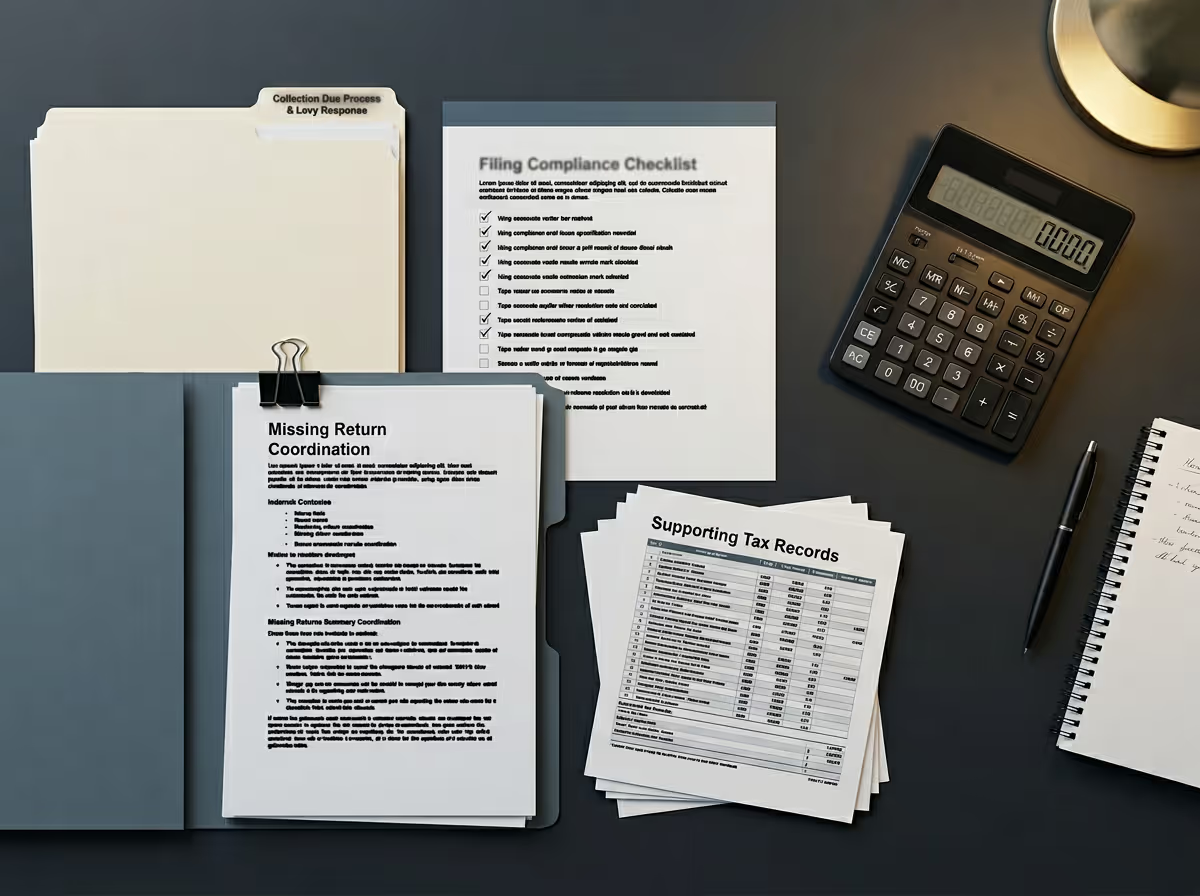
If enforcement action is pending, we act quickly to preserve your rights. We review whether you are within the 30-day window to request a collection due process hearing and determine whether other protections may apply. When necessary, we contact the appropriate IRS division to prevent or delay levy action while we stabilize your case and organize the next steps.
Compliance Alignment
Before pursuing resolution programs, we ensure that all required federal tax returns are properly filed. The IRS generally requires compliance with filing requirements before approving installment agreements or considering an offer in compromise. We coordinate any missing filings carefully so that financial disclosures and tax positions are consistent, accurate, and defensible during negotiations.
Resolution Strategy Development
After enforcement risk is controlled and compliance is addressed, we evaluate the most appropriate resolution path. This may include an installment agreement, an offer in compromise, or another collection alternative, depending on your income, necessary expenses, and asset equity. We prepare supporting documentation to present a clear and realistic proposal to the IRS.
Ongoing Monitoring and Communication
Representation does not end once a proposal is submitted. We monitor IRS responses, track processing timelines, and confirm that agreements are properly recorded. We promptly respond to requests for additional documentation. Continued oversight helps prevent unexpected enforcement actions and ensures your case remains stable as you move toward a long-term resolution.

What Happens If You Do Nothing
You may receive escalating IRS notices demanding payment, as described in Publication 594.
The IRS may issue a Final Notice of Intent to Levy, giving you 30 days to request a hearing before the levy takes effect.
Interest and penalties continue to accrue on unpaid balances during this period.
If no arrangement is made, the IRS may begin enforcement collection actions under its statutory authority.
Federal tax refunds may be applied automatically to outstanding tax debt.
A federal tax lien may be imposed if the assessment and demand for payment are not resolved.
The IRS may issue a bank levy, and the bank will hold funds for 21 days before sending them to the IRS, according to Publication 594.
The IRS may initiate and maintain wage garnishment until it resolves or releases the debt.
Federal enforcement may reduce your ability to negotiate effectively with state agencies.
Frequently Asked Questions (FAQs)
Take Action Now
Multi-state tax problems do not resolve themselves. Federal enforcement authority is clearly outlined in IRS Publication 594. Once deadlines expire, options narrow significantly.
If you are encountering IRS enforcement alongside state tax issues, please reach out to us at your earliest convenience. We will review your notices, file a power of attorney, and take control of communication before levies or liens disrupt your finances.
Results depend on individual circumstances and IRS determinations. No outcome is guaranteed. Representation is subject to IRS rules and procedures. IRS Circular 230 Disclosure applies.