Thank you for contacting
GetTaxReliefNow.com!
or wage garnishment — call us now at +(888) 260 9441 for immediate help.



OBBB Changes Who Should Itemize in 2026
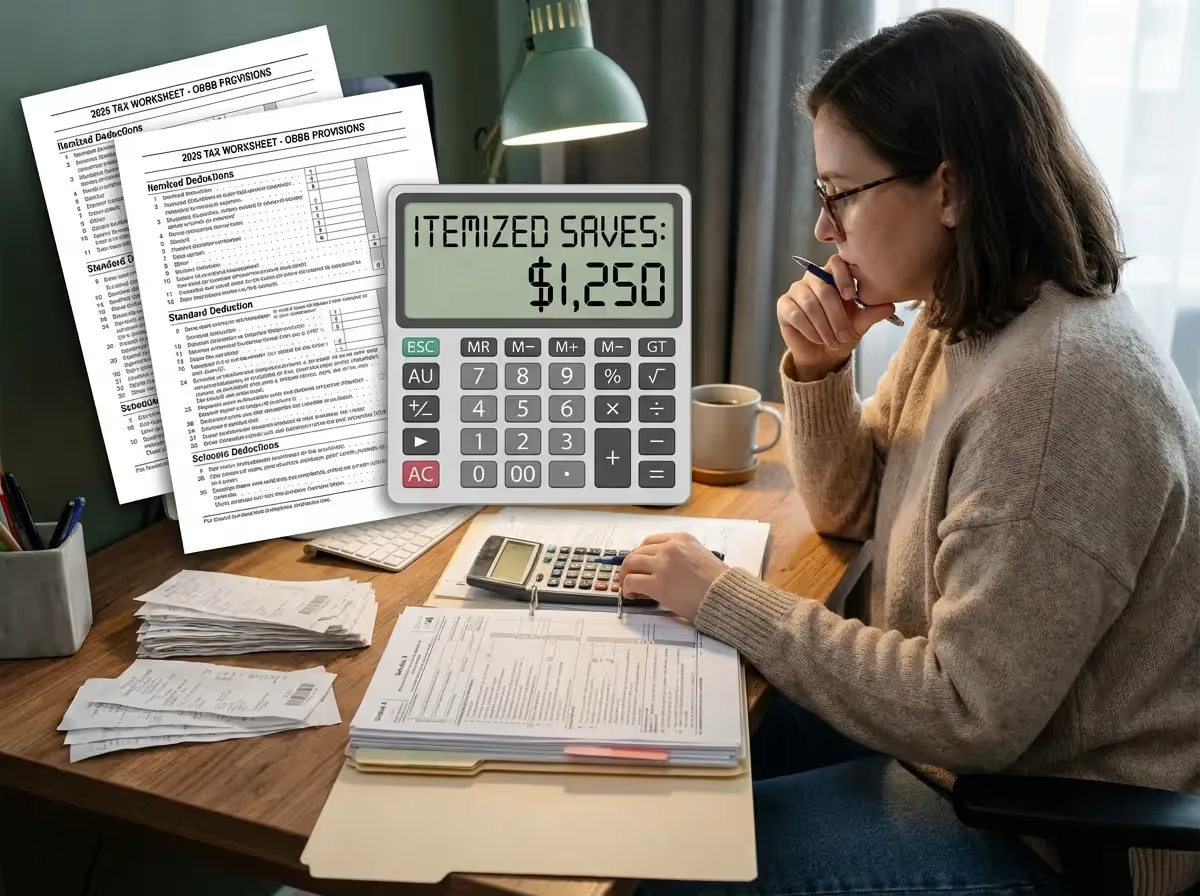
The One Big Beautiful Bill Act resets the deduction calculation for millions of taxpayers in 2026, raising the standard deduction, expanding the SALT cap, and adding a new high-income limit on itemized deductions. The changes require filers to reassess whether Schedule A delivers more savings than the larger standard deduction.
IRS Raises Standard Deduction, Narrowing the Case for Itemizing
For tax year 2026, the Internal Revenue Service set the standard deduction at $16,100 for single and married filers filing separately, $32,200 for married filers filing jointly, and $24,150 for heads of households. Those higher thresholds increase the hurdle taxpayers must clear before itemizing reduces taxable income.
The larger standard deduction continues a pattern seen in recent years, when most filers chose not to itemize. Under OBBB, the break-even point shifts again, meaning taxpayers must run a fresh comparison using updated 2026 figures.
Filing Status and Income Now Drive the Break-Even Calculation
Because the standard deduction varies by filing status, the decision to itemize depends heavily on whether a taxpayer files as single, married filing jointly, married filing separately, or head of household. Adjusted gross income also shapes the outcome, mainly when medical expense thresholds or SALT (State and Local Tax) phase-down rules apply.
In practical terms, taxpayers must total their allowable itemized deductions on Schedule A and compare that figure with the standard deduction for their filing status. The higher number determines the deduction taken on Form 1040.
Expanded SALT Cap Reopens the Door for High-Tax States
The One Big Beautiful Bill Act raises the SALT deduction cap to as much as $40,400, or $20,200 for married filing separately. That increase marks a significant change from the prior $10,000 cap and could shift the itemizing decision for homeowners in high-tax states.
However, the expanded cap phases down once modified AGI exceeds $505,000, or $252,500 for married filing separately. Even after that reduction, the allowable SALT deduction generally will not fall below $10,000 or $5,000 for married filing separately.
SALT Phase-Down Reduces Benefits at Higher Income Levels
For higher-income households, the SALT benefit declines as income exceeds the threshold. Taxpayers near or above that level must calculate how much of their state and local taxes remains deductible before deciding whether Schedule A totals exceed the standard deduction.
The practical effect is that middle- and upper-middle-income homeowners in high-tax states may benefit more from the expanded cap than ultra-high earners subject to the phase-down.
Mortgage Interest and Charitable Giving Continue to Shape Itemized Totals
Mortgage interest remains deductible, subject to existing loan limits and qualification rules. Taxpayers early in a mortgage term typically pay more interest, which can significantly increase Schedule A totals.
Charitable contributions to qualified organizations remain deductible, provided they are correctly documented and fall within the percentage-of-income limits. For households that give consistently, charitable deductions can materially affect the standard versus itemized comparison.
Medical Expenses Above 7.5% of AGI Can Shift the Outcome
Unreimbursed medical and dental expenses remain deductible only to the extent they exceed 7.5% of adjusted gross income. Major medical procedures, extended treatment, or high insurance cost-sharing can push total expenses above that threshold.
Because of the AGI floor, routine medical spending often produces little or no deduction. The impact becomes significant only when expenses exceed the 7.5% benchmark.
OBBB Imposes New High-Income Limits on Itemized Benefits
Beginning in 2026, OBBB introduces a new limitation on the tax benefit of itemized deductions for certain high-income taxpayers. According to the Congressional Research Service analysis, the law reduces the effective value of some itemized deductions through a fractional mechanism tied to top tax bracket thresholds.
Policy analysts describe the change as limiting the maximum benefit rate of itemized deductions, meaning taxpayers in the 37% bracket may not receive the full marginal advantage on every deductible dollar. This reduces the apparent tax savings from large Schedule A totals at the highest income levels.
High Earners Must Recalculate After Applying Benefit Limits
Taxpayers in the top-bracket range should rerun their calculations after factoring in the new limitation. In some cases, the adjusted benefit narrows the gap between itemized deductions and the standard deduction, potentially changing the final decision.
For very high-income households, the comparison is no longer just about which deduction is larger. It is also about how much of that deduction translates into actual tax savings.
Most Taxpayers Still Expected to Take the Standard Deduction
Despite the expanded SALT cap, most filers nationwide are expected to continue claiming the standard deduction. Policy analysts have noted that more than 90% of taxpayers used the standard deduction in prior years, and the larger 2026 amounts reinforce that pattern.
Itemizing becomes more likely when multiple factors align, including substantial SALT payments within the allowable cap, high mortgage interest, consistent charitable contributions, and significant medical expenses relative to AGI. Taxpayers with only one of these factors may still find the standard deduction larger.
For 2026, the decision structure remains straightforward. Taxpayers must total allowable Schedule A deductions, apply SALT caps and income-based reductions, and compare the result against the updated standard deduction before filing. Under the One Big Beautiful Bill Act, that comparison carries new weight, particularly for homeowners and high-income filers.
Sources
- IRS Releases Tax Inflation Adjustments for Tax Year 2026, Including Amendments from the One Big Beautiful Bill
- Schedule A (Form 1040) Instructions
- One Big Beautiful Bill Provisions: Individuals and Workers
By William Mc Lee, Editor-in-Chief & Tax Expert—Get Tax Relief Now
If you need help with a tax issue discussed in this article, you can reach a licensed tax professional at Get Tax Relief Now at (888) 260-9441 or visit our contact page.
Thank you for submitting!
Start My Confidential, No-Judgment Case Review
Ready to stop penalties and garnishments? Complete the form or call/email us directly—our experts are standing by to assist.

Have a question?
+ (888) 260 9441
Write email
info@gettaxreliefnow.com
Address