Thank you for contacting
GetTaxReliefNow.com!
We’ve received your information. If your issue is urgent — such as an IRS notice
or wage garnishment — call us now at +(888) 260 9441 for immediate help.
or wage garnishment — call us now at +(888) 260 9441 for immediate help.
Oops! Something went wrong while submitting the form.


IRS Form 940 (2019): Employer's Annual FUTA Return
Download, complete, and file your 2019 FUTA return with confidence, even if you're filing late. Access the official form, follow year-specific instructions, and resolve any outstanding balance before penalties grow further.
Official IRS form · Instant download · No signup required

Form DOwnload
✔ Official IRS Document
Download the form, access your records, or get guided help
What Is This Form
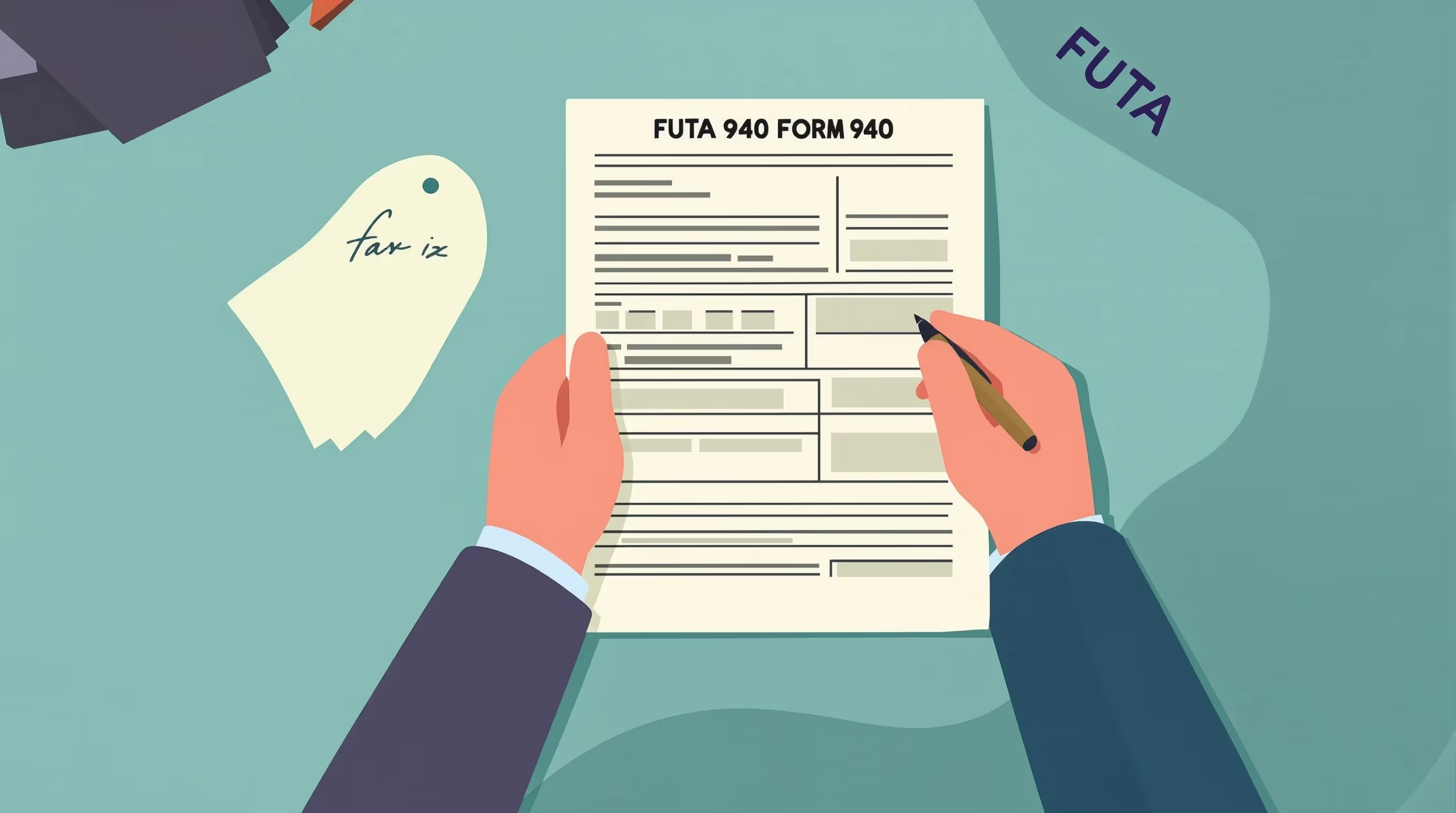
IRS Form 940 (2019) is used by employers to report and pay their annual federal unemployment tax under the Federal Unemployment Tax Act. It applies to businesses that paid qualifying wages to employees during the 2019 tax year and met the federal filing thresholds established by the IRS.
Late Filers
Employers who missed the Form 940 deadline should file promptly to reduce additional failure-to-file penalties on any unpaid FUTA tax balance.
Multiple Income Sources
Employers paying wages in multiple states must report accurately and attach Schedule A when required for credit reduction or multi-state unemployment tax reporting.
Itemizing Deductions
Form 940 requires excluding FUTA-exempt payments like fringe benefits, since only the first $7,000 of each employee’s annual wages is taxable.
Claiming 2019 Credits
Employers who pay state unemployment taxes on time may claim a 5.4 percent credit, reducing the standard 6.0 percent FUTA rate.
IRS Compliance
Failure to file Form 940 accurately can result in penalties, interest charges, and IRS enforcement actions for underreported or unpaid FUTA liability.
Citizens Abroad / Military
U.S. employers with workers abroad may still owe FUTA if they are classified as American employers under federal law, depending on the wages paid overseas.
Eligibility
Form 940 is required for employers meeting federal FUTA thresholds during 2019, including those paying $1,500 in wages per calendar quarter or employing one or more employees for at least part of a day in 20 weeks.
Late Filers
Employers who missed the January 31, 2020, deadline should still file Form 940, as filing stops additional failure-to-file penalties from increasing further.
Multiple Income Sources
Employers paying wages in multiple states must complete Schedule A and line 1b on Form 940 to report accurate wage distribution and credits.
Itemizing Deductions
Employers must exclude FUTA-exempt wages and amounts above $7,000 per employee before calculating taxable FUTA wages for 2019 federal unemployment tax purposes.
Claiming 2019 Credits
Employers may claim up to a 5.4 percent credit for timely state unemployment tax payments, reduced in states like the U.S. Virgin Islands.
IRS Compliance
Employers receiving IRS notices for missing 2019 Form 940 should file promptly using the correct form to resolve issues and reduce penalties.
Citizens Abroad / Military
Employers paying U.S. citizens abroad in 2019 must determine FUTA applicability based on their status as American employers under federal unemployment tax rules.
Step-by-Step
Follow the steps below to complete and file your 2019 FUTA return accurately. Several instructions are specific to the 2019 tax year and differ from other versions of the form.
1. Gather your documents before starting
Collect all 2019 payroll records, including wage summaries, FUTA deposit receipts, state unemployment tax payment documentation, and related IRS correspondence. Having complete records before starting reduces calculation errors, supports accurate line entries, and ensures smoother Form 940 preparation and review.
2. Choose the correct filing status
Confirm you are using the official 2019 Form 940 before filing. Status boxes include amended return, successor employer, no payments to employees in 2019, and final return. There is no “original filing” box, and using outdated or incorrect labels can delay processing, trigger IRS corrections, and create unnecessary compliance issues or additional correspondence.
3. Report all income on the correct lines
Report total payments to employees on Line 3, FUTA-exempt wages on Line 4, and wages above $7,000 per employee on Line 6. Line 7 calculates taxable FUTA wages. Only taxable wages are subject to FUTA, and correct classification ensures accurate unemployment tax computation, proper reporting, and compliance with federal unemployment tax requirements.
4. Calculate Adjusted Gross Income (AGI)
Multiply taxable FUTA wages by 0.006 on Line 8 to determine preliminary FUTA tax. Lines 9 and 10 adjust for credit eligibility and unpaid or late state unemployment taxes. These adjustments determine final FUTA liability before credits or penalties are applied.
5. Choose your deductions and apply exemptions (2019 Only)
Apply FUTA credits for timely payments of state unemployment taxes made on the same wages. Adjustments on Lines 9 and 10 account for reduced credits or late payments. Employers in credit-reduction states must also complete Schedule A and include additional tax on Line 11, ensuring accurate FUTA liability reporting and full IRS compliance for 2019.
6. Claim the 2019-specific credit (2019 Only)
Employers in credit-reduction states such as the U.S. Virgin Islands must complete Schedule A (Form 940) and attach it to their return. The 2019 credit reduction increased FUTA liability, requiring additional tax reporting on Line 11 for full compliance.
Filing Deadline — January 31, 2020
The original due date for IRS Form 940 (2019) was January 31, 2020, with an automatic extension to February 10, 2020, for employers who deposited all FUTA tax on time. Late filers should submit promptly, as interest accrues on unpaid balances from the original deadline.
Refund Deadline — Likely Expired
Refund or credit claims for overpaid 2019 FUTA tax are generally limited to the later of three years from filing or two years from payment, whichever is later. Most employers’ windows have likely closed, though rare exceptions may still apply in specific circumstances.
Processing Time — Allow Several Months
IRS processing times for prior-year employment tax returns vary and are not guaranteed. Employers owing tax should not wait for a notice before paying, as early payment helps reduce additional failure-to-pay penalties and interest that continue accumulating until the balance is fully resolved.
Amended Returns and Prior-Year Corrections
Employers correcting a 2019 Form 940 must file using the 2019 version and check the amended return box. Any additional tax owed should be paid upon filing, while the IRS generally calculates penalties and interest separately through subsequent notices rather than on the return itself.
Missing W-2s or Tax Records for 2019?
Late filers often no longer have access to their original 2019 payroll documents. IRS records and prior employer contacts can help reconstruct the wage information needed to complete and file your return accurately.
IRS Wage & Income Transcript
An IRS wage & income transcript shows W-2, 1099, and third-party income reported for 2019. It can be requested through the IRS Get Transcript to help reconstruct filing records accurately.
IRS Account Transcript
An IRS account transcript shows payments, penalties, and IRS actions on your 2019 business tax account, helping verify reported amounts before filing late or amended Form 940 returns.
Social Security Administration
SSA records tied to your Employer Identification Number may verify 2019 wages reported through W-2 filings. SSA can also assist with corrections or confirmation of wage data accuracy.
Contact Prior Employers
Federal law requires payroll records to be retained for at least 4 years, so former employers may still have 2019 wage documentation needed to support Form 940 filings.
Filing late is better than not filing, since the failure-to-file penalty accrues at 5% per month rather than 0.5% for failure-to-pay, reducing total exposure.
Missing W-2s or Tax Records?
You can still complete your return even without original records
Penalties and interest on any unpaid 2019 FUTA balance have been accruing since January 31, 2020. Filing your return now stops the failure-to-file penalty from continuing to increase and reduces the total amount you will ultimately owe.
Failure-to-File Penalty
(5% per month, up to 25%)
The failure-to-file penalty is charged at 5% of the unpaid tax for each month or partial month the return is late, up to 25%. It applies separately from interest and continues until the IRS receives the filed return.
Failure-to-Pay Penalty
(0.5% per month + interest)
The failure-to-pay penalty accrues at 0.5% of the unpaid balance per month, plus interest based on the federal short-term rate plus 3%. When both penalties apply, the failure-to-file penalty is reduced by the failure-to-pay amount for that month.
Penalty Abatement Options
(First-Time Abatement & Reasonable Cause)
Taxpayers with a clean compliance history may qualify for a first-time abatement to have certain penalties removed. Reasonable cause relief may apply when circumstances prevented filing. Requests are submitted with Form 843 after the IRS issues an assessment notice.
Filing late is better than not filing at all, since the failure-to-file penalty is 5% monthly versus 0.5% for failure-to-pay, reducing total IRS penalty exposure.
The following errors are common causes of IRS delays, rejected returns, or missed credits on 2019 Form 940 filings.
- Using the wrong tax year form — Submitting a Form 940 from an incorrect year causes calculation errors, IRS mismatches, and requests to refile prior-year returns with potential penalties assessed later.
- Missing Schedule M / 2019-specific credit — Omitting Schedule M or required year-specific credits for multi-state wages can result in incomplete filings and delayed IRS processing or adjustments.
- Wrong filing status label — Selecting the wrong employer classification or filing status box may misclassify the return, trigger IRS correspondence, and significantly delay processing times.
- Applying Pease limitations incorrectly — Incorrectly applying limitation rules or wage exclusion thresholds can distort taxable wages, resulting in inaccurate FUTA liability calculations and IRS corrections.
- Treating unemployment compensation as partially tax-free — Improperly excluding wages above the FUTA taxable threshold or treating unemployment compensation as partially tax-free can lead to underreported liability and penalties.
- Assuming a refund is still available — Assuming eligibility for 2019 FUTA refunds without checking statutory deadlines may result in denied claims, since most refund windows are closed.
- Missing or incorrect Social Security numbers — Payroll records with missing or incorrect Social Security numbers create IRS mismatches, delay verification, and complicate the resolution of employment tax filings.
- Unsigned return — Submitting an unsigned Form 940 invalidates the return, causing rejection, restarting deadlines, and potentially increasing penalties or late filing consequences.
- Missing attachments — Omitting attachments like Schedule A or required supporting documents results in incomplete filings and may trigger IRS correspondence or adjustments.
What is IRS Form 940 (2019) used for?
IRS Form 940 reports annual federal unemployment insurance tax under the Federal Unemployment Tax Act (FUTA) for employers, including corporations and S corporations, to the federal government. It funds unemployment insurance programs for eligible workers, excluding household employees and most agricultural employers generally.
Can I still file a 2019 Form 940?
Yes, you can still file a 2019 Form 940 for the calendar year even after the original deadline for the preceding year has passed. Filing helps address underpayment issues, reduce costs, and prevent penalties. Refer to IRS guidance or visit resources for future additional information.
What was the FUTA tax rate for 2019?
The 2019 Federal Unemployment Tax Act (FUTA) rate was 6.0 percent on the first $7,000 of wages paid to the federal government. Employers could receive a maximum credit of 5.4 percent for timely state unemployment tax payments, significantly reducing overall costs.
What happens if I owe FUTA tax from 2019?
If you owe FUTA tax under the Federal Unemployment Tax Act, the federal government may charge interest and penalties on underpayment from the calendar year due date. Costs increase over time, so filing promptly or arranging payment can significantly reduce the future financial impact.
Can I still get a refund for the overpaid 2019 FUTA tax?
The refund window for 2019 FUTA tax is generally limited to three years from the filing date or two years from the payment date, depending on the calendar-year and preceding-year rules. Corporations, partnerships, and other employers should refer to IRS guidance and visit official resources.
Do I need to file Schedule A with my 2019 Form 940?
Schedule A (Form 940) is required for employers who pay unemployment insurance in multiple states or in credit-reduction areas, such as agricultural employers or those with household employees in special cases. It ensures that maximum credit calculations are accurate and properly reported, with supporting details.
How do I correct a previously filed 2019 Form 940?
To correct a 2019 Form 940, file an amended return using the original year form and indicate corrections clearly. Include supporting documentation, pay any underpayment, and refer to IRS instructions. Visit official resources for additional guidance and ensure accurate reporting for future compliance.
Let's Get It Done — Accurately.
We'll help you file your federal tax return correctly, reduce penalties, and resolve what you owe the IRS.