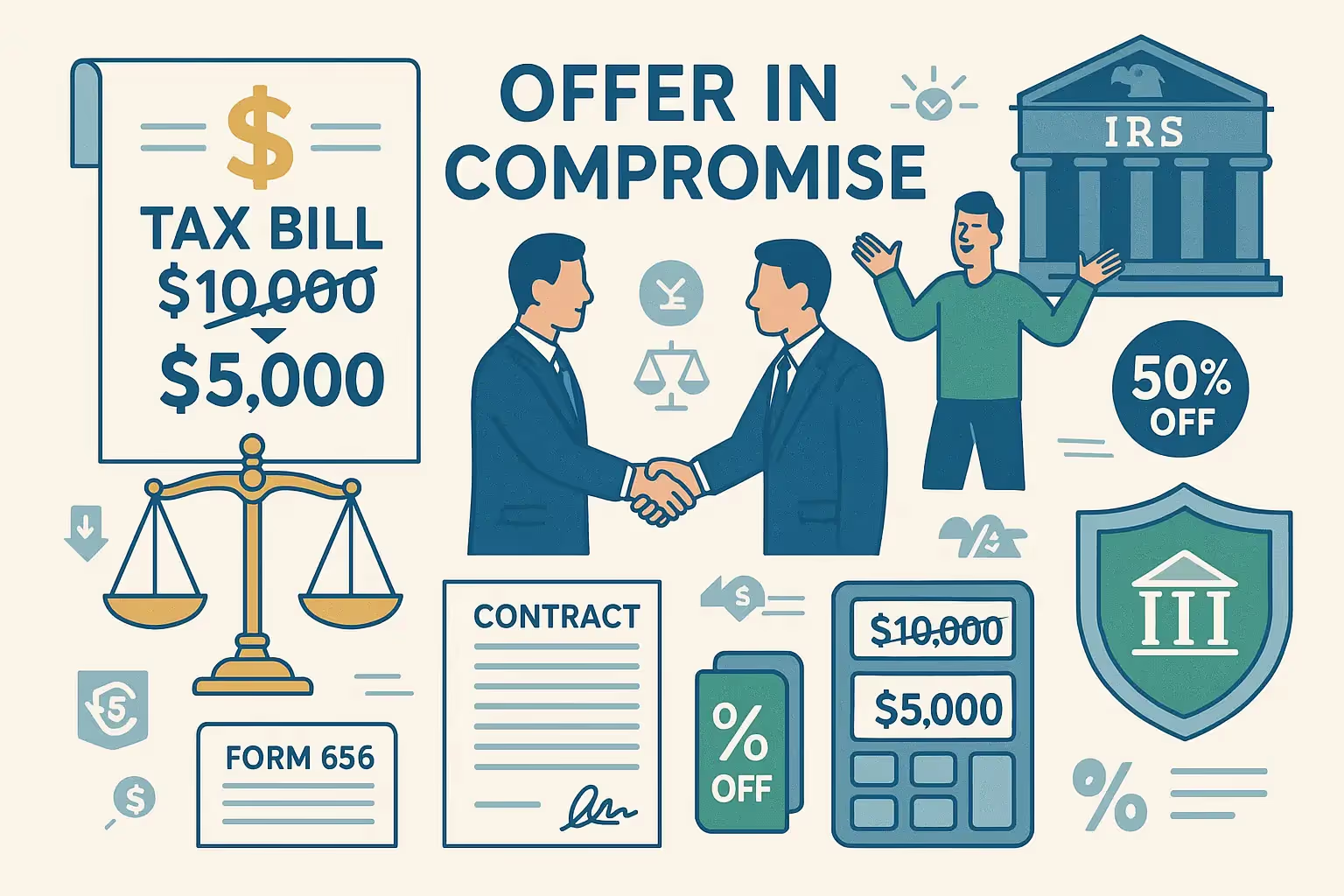


When unpaid tax debt gets too big, many taxpayers have trouble paying for basic needs. The IRS can help you with its Offer in Compromise (OIC) program if paying all of your taxes puts you in a lot of financial trouble. This option lets people who qualify pay less than the full amount of their taxes.
The IRS reviews income, expenses, assets and the offer basis. A collectibility offer generally will not be accepted if the debt can be paid in full through assets and a payment arrangement. Effective tax administration can support an offer in qualifying hardship or exceptional circumstances despite an ability to pay; a disputed liability uses a separate Form 656-L process.
This guide will help you understand how the compromise program works, determine if you qualify, and walk you through each step of the application process. It also explains how the IRS review process functions, what documents are required, and which mistakes to avoid. Whether you are a wage earner, self-employed individual, or facing long-term economic hardship, this guide will help you make informed decisions about resolving your tax problems through the OIC program.
What Is an Offer in Compromise?
An Offer in Compromise (OIC) is a tax relief option that the Internal Revenue Service provides. It lets some taxpayers pay off their tax debt for less than the full amount they owe. It is for people and businesses who are having trouble with money and can't pay all of their taxes without cutting back on their basic needs.
The compromise program is how the IRS settles cases where getting the full amount is unlikely or unfair. Instead of aggressively going after people, the IRS looks at the taxpayer's financial situation to see if a lower amount is acceptable. The goal is to find a reasonable middle ground that benefits both the taxpayer and the government.
The IRS uses a Reasonable Collection Potential (RCP) calculation to determine the worth of each offer. This formula helps the IRS determine how much money it can realistically expect from income, assets, and monthly payments.
Essential things to think about when evaluating are:
- Income and Expenses
The IRS looks at your income and allows monthly expenses to determine how much money you have left. - Asset Equity
After deducting certain exemptions, the IRS considers the value of your assets, including property, bank accounts, and investments. - Payment Ability
The IRS may consider a compromise if your limited ability to pay does not cover the total tax bill.
Submitting an OIC does not guarantee acceptance. The IRS evaluates the applicable offer basis and supporting evidence. Inability to pay in full is central to doubt as to collectibility; effective tax administration and doubt as to liability have different requirements.
An Offer in Compromise can help taxpayers resolve tax problems when other payment plans are not feasible.
Eligibility Criteria and Qualifications
Taxpayers following strict rules and good money habits can apply for the IRS Offer in Compromise (OIC) program. You need more than just a bill from the IRS to be eligible. The IRS carefully checks your income, expenses, tax history, and asset equity to see if a lower settlement is fair.
Requirements for General Eligibility
For an offer in compromise to be considered, the following things must be true:
- Filing compliance
You must have submitted all required tax returns. If any are missing, the IRS will not process your application. - Estimated tax payments
Wage earners and self-employed individuals must be current with estimated tax payments for the current tax year. - No open bankruptcy
Taxpayers currently in an open bankruptcy proceeding are ineligible. You must wait until the case is closed before applying. - Federal tax deposits
Business owners with employees must be current on all required federal tax deposits for the current and previous two quarters.
Financial Qualifications
Compliance is only the first step. For a collectibility offer, the IRS generally will not compromise a debt that can be paid in full through assets or an installment agreement. Review the separate effective-tax-administration criteria if full payment would create qualifying hardship or exceptional unfairness.
Key financial considerations include:
- Monthly disposable income
Your income is reviewed against your basic living expenses to determine your capacity for monthly payments. - Asset equity
The IRS evaluates the equity in your bank accounts, vehicles, property, and other assets. - Special circumstances
In cases of economic hardship, the IRS may approve a compromise based on effective tax administration, even when the ability to pay exists.
For a doubt-as-to-collectibility offer, document why assets and future income will not satisfy the debt in full. Financial hardship is not the only offer basis. Effective-tax-administration requests require evidence of the qualifying hardship or exceptional circumstances described in the IRS instructions.
Understanding the Application Process and Payment Options
Applying for an Offer in Compromise (OIC) requires accurate documentation, IRS-approved forms, and a complete understanding of your financial condition. The Internal Revenue Service does not automatically accept offers. It carefully evaluates whether settling for less than the full amount is in the government’s best interest.
Use the IRS Pre-Qualifier Tool
The IRS provides an offer for the Compromise Pre-Qualifier Tool online. This tool allows you to check whether you may qualify based on your income, expenses, asset equity, and overall financial state. If you are ineligible, this process can help you avoid unnecessary paperwork.
Gather Required Documentation
To support your financial claims, you will need to collect and send in the following documents:
- You need to show proof of income from the last few months, such as pay stubs or benefit statements.
- You have to send in copies of your most recent tax returns.
- You need to include your most recent bank and investment account statements.
- You need to send in papers that prove you own the property and the mortgage.
- You need to give a list of your monthly living costs.
- You must show proof of financial trouble, like medical bills or court orders.
If you don't include all the necessary documents, the IRS may return your application without looking at it.
Complete the Collection Information Statement
You must submit one of the following forms:
- You should complete Form 433-A (OIC) if you are an individual or a self-employed individual.
- You must use Form 433-B (OIC) if you submit on behalf of a business.
These forms collect detailed financial information, including income, monthly payments, and asset equity. The IRS uses this data to determine your reasonable collection potential and whether your tax debt can be resolved through other means, such as an installment agreement.
Fill Out Form 656
Form 656 identifies the tax periods and liabilities you want to compromise. It has the amount of your offer and the payment method you chose. This form must be signed and submitted with your financial statement and supporting documentation.
Choose a Payment Option
You must select one of the two IRS-approved payment options:
Lump Sum Offer
This option allows you to pay your taxes in five or fewer installments. You must send in 20% of your total offer amount as a nonrefundable initial payment when you apply. You have five months to pay the rest of the money if your offer is accepted.
Periodic Payment Offer
You can pay for this option in monthly installments over 6 to 24 months. You need to send in the first month's payment with your application. You will also need to keep paying every month while the IRS looks over your offer. These payments are nonrefundable, even if the IRS rejects the offer.
Submit the Complete Application Package
Your package must include all of the following items:
- You must include a signed and completed Form 656.
- Depending on your status, you are required to submit Form 433-A (OIC) or Form 433-B (OIC).
- You must attach all required financial documentation.
- You must include the $205 application fee unless you qualify for low-income certification.
- You must submit the required initial payment based on your selected payment option.
If anything is missing, the IRS will return your submission without review.
Wait for the Review Process
The IRS review process can take several months. During this time, the IRS will evaluate your income, asset equity, and monthly disposable income. They may also request additional documentation. Most collection actions are suspended, although the IRS may file a federal tax lien.
Economic Hardship Considerations
Some taxpayers who apply for an Offer in Compromise may be able to pay their tax debt in full. However, the Internal Revenue Service may still approve a reduced settlement under the principle of effective tax administration. This exception applies when paying the full tax bill, which would result in significant economic hardship or unfair outcomes.
Economic hardship occurs when full payment prevents taxpayers from meeting basic living expenses. Some examples are long-term illness, disability, limitations that come with getting older, or caring for dependents with special needs. The IRS might accept a lower offer even if the taxpayer appears to have sufficient assets, as collecting the full amount could negatively impact the taxpayer's finances over time.
Taxpayers must send in paperwork that explains their situation to be eligible for this reason. This means
- The documentation must provide proof of limited income and high essential expenses.
- If applicable, medical records should also be included.
- Statements confirm the asset values and monthly responsibilities.
The IRS reviews these offers carefully. While not automatically accepted, an offer may be approved if full installment payments or asset liquidation cause serious financial strain. The goal is to balance tax collection with long-term taxpayer stability.
For example, if a person owes money and owns a modest home, but selling it would leave them homeless or unable to afford medical treatment, the IRS may approve a reduced offer. The same may apply if installment payments severely disrupt their financial conditions.
When economic hardship exists, the IRS accepts that compromise supports future compliance. It also reflects the agency’s broader goal of resolving tax problems in a way that considers the taxpayer’s ability to recover and remain financially stable.
Compromise Benefits and Long-Term Obligations
Taxpayers with a lot of tax debt can get immediate and long-term help from an approved Offer in Compromise. The primary benefit is financial relief. By settling for less than the full tax bill, eligible taxpayers can stop collection actions and begin the path toward financial recovery.
Once an offer is pending, levy restrictions generally apply subject to exceptions, but an existing levy is not automatically released. The IRS may still file a Notice of Federal Tax Lien. Existing federal tax liens generally are not released until the accepted offer is paid in full and the applicable terms are satisfied.
Another good thing about it is that it is predictable. The taxpayer knows precisely how much they need to pay to settle their debt, so there is no doubt. However, any initial or monthly payments submitted with the offer are considered nonrefundable, even if the IRS later rejects the application.
Here is a compromise overview of the post-approval responsibilities:
- You must remain in full compliance for five years after acceptance.
- You are required to file all tax returns on time.
- You must timely file required returns and pay taxes during the five-year period beginning with acceptance through the fifth year, as required by current Form 656. You must also pay the accepted offer and satisfy its other terms.
- If required, stay current on estimated tax payments and, if you are an employer, federal tax deposits.
If you don't adhere to these terms, the IRS may default on the offer and restore the original balance. Maintaining compliance is critical to retaining the benefits of the accepted compromise.
An Offer in Compromise is not just a solution to immediate tax problems—it is a long-term commitment. While the program relieves taxpayers who owe money and cannot pay in full, it requires continued responsibility. Those who complete the program successfully often gain lasting financial stability.
Low-Income Certification Guidelines
The IRS has a Low-Income Certification program that helps low-income people use the Offer in Compromise program. This certification eliminates the application fee and suspends initial and monthly nonrefundable payments during the review process.
For an individual’s Low-Income Certification, compare either adjusted gross income from the most recent Form 1040 or current gross monthly household income multiplied by 12 with the current Form 656 table for family size and residence. Income must be at or below the applicable limit. Use the current form rather than a prior-year threshold.
To qualify, all of the following must apply:
- Your income falls at or below the threshold for your household size.
- You have filed all required tax returns.
- You are not in an open bankruptcy proceeding.
- You correctly completed the Low-Income Certification section of Form 656.
If approved, you are not required to pay the $205 application fee or submit an initial payment with your offer. This eases the financial burden for taxpayers facing economic hardship.
But getting Low-Income Certification doesn't mean that your offer will be accepted. You still need to send in all the necessary paperwork and show that your financial situation makes it impossible to pay off your tax debt in full.
This choice is beneficial for people who work for someone else or are self-employed and meet strict income limits. By reducing upfront costs, Low-Income Certification allows more taxpayers to access the compromise program and seek resolution to their tax problems without worsening their financial situation.
Collection Actions and Processing Time Frames
Mailing an offer does not immediately establish levy protection. Confirm that the IRS has accepted it for processing and it is pending. Applicable levy restrictions do not automatically release an existing levy or prevent a Notice of Federal Tax Lien. Follow any existing payment-plan obligations until the IRS confirms the offer’s processing status and applicable payment rules.
The review process typically follows two phases:
- Initial processing (30–60 days): The IRS checks whether your application includes all required tax returns, the application fee, and the initial or monthly nonrefundable payment. If anything is missing and you do not qualify for Low-Income Certification, the application will be returned.
- A detailed evaluation (6–24 months): While the application is under review, an offer examiner will look at your case if it is accepted for review. The IRS evaluates your income, expenses, taxpayer’s assets, and overall financial condition. You may be asked to provide additional documentation to support your financial claims.
- You are required to stay current on tax filings and estimated payments.
- If you selected periodic payments, continue the required monthly payments while the offer is considered unless you qualify for Low-Income Certification.
The IRS notifies you in writing once it makes a decision. If the IRS rejects the offer, you have 30 days to file an appeal. Giving accurate and complete financial documents can help you avoid delays and increase your chances of success.
If you know how this process works, you can avoid problems and get ready for each step.
Frequently Asked Questions About the Compromise Program
What is a tax debt, and how does the Offer in Compromise help resolve it?
A tax debt is the total amount a taxpayer owes the IRS, including the original tax, penalties, and interest. The Offer in Compromise allows qualified individuals to settle their tax debt for less than the full balance when they meet strict eligibility criteria, such as financial hardship or inability to pay based on current income and asset equity.
Does the IRS always accept Offers in Compromise?
No, the IRS does not automatically approve every offer. Each application undergoes a detailed financial review. The IRS accepts offers when the amount reflects what it can reasonably collect. It will likely be rejected if the offer falls below your reasonable collection potential without valid justification.
How much is the Offer in Compromise application fee?
The standard application fee is $205. However, the IRS waives the application fee if you qualify for Low-Income Certification. The fee is nonrefundable and must be included with your application unless exempt. Applications without the required payment or fee waiver documentation will not be processed.
How does effective tax administration apply to my case?
When collecting the full tax bill would cause serious economic problems, even if the taxpayer has enough money, effective tax administration is considered. This applies in situations involving disability, chronic illness, or support obligations. The IRS might agree to a compromise if enforcing full collection would be unfair or not help.
What happens if I default after the IRS accepts my offer?
The IRS may cancel the agreement if you don't keep up with your obligations under your accepted compromise, like filing future tax returns or paying new taxes. This could result in reinstating your original tax debt, minus payments already made, and resuming collection activities.
Can I settle my tax bill without using the Offer in Compromise program?
Yes, alternatives include installment agreements and Currently Not Collectible status. These options don’t reduce your tax bill but may make payments more manageable. The compromise: The program is only for taxpayers who can't pay the full amount and meet IRS relief requirements.
Where can I find a complete compromise overview before applying?
You can review the full Offer in Compromise process in IRS Form 656-B, the official booklet that outlines eligibility, documentation, and payment options. This compromise overview helps you understand what the IRS expects before you apply. It’s available at IRS.gov or by calling the IRS directly.