



The short answer
- Illinois is running a Remote Retailer Tax Amnesty window August 1–October 31, 2026.
- It targets out-of-state sellers with no Illinois physical presence that met a remittance threshold and still have unpaid remote-retailer Retailers' Occupation Tax for sales January 1, 2021–June 30, 2026.
- Simplified rates: 9% general merchandise; 1.75% qualifying reduced-rate items (records required).
- Related penalties and interest may be waived if you pay in full in the window or finish an approved plan (plan default can unwind relief).
- Apply only in MyTax Illinois after registration. Confirm details on the official IDOR amnesty page before filing.
- For broader Illinois resolution options, see Illinois tax relief.
Quick eligibility screener (educational)
Answer these five questions before you dig into the full guide. This is not an IDOR determination. Answer yes/no:
| Item | Detail |
|---|---|
| Program name | 2026 Illinois Remote Retailer Tax Amnesty Program |
| Legal authority | 35 ILCS 120/2-13 (P.A. 104-0006; see also P.A. 104-468) |
| Agency | Illinois Department of Revenue (IDOR) |
| Application window | August 1, 2026 – October 31, 2026 |
| Eligible sales periods | January 1, 2021 – June 30, 2026 |
| Who it targets | Remote retailers (no Illinois physical presence) that met a tax remittance threshold |
| Simplified rates | 9% general merchandise; 1.75% qualifying reduced-rate items |
| Relief | Related penalties and interest waived if tax paid in full or approved plan completed |
| Filing method | Electronic only — Remote Retailer Amnesty Application in MyTax Illinois |
| Payment plans | Up to 24 months (6, 12, 18, or 24); down payment required; ACH starts Dec. 1, 2026 |
| Non-participation risk | Audit exposure; undetermined-location assessments may use a 15% rate |
| Official bulletin | IDOR FY 2026-28 (June 2026) |
| Amnesty contacts | REV.TA-Amnesty@illinois.gov; 800-732-8866 or 217-782-3336; TTY 800-544-5304 |
| Registration help | Central Registration Division: 217-785-3707; rev.crd@illinois.gov |
Timeline
| Date | Event |
|---|---|
| January 1, 2021 | Leveling the Playing Field remote-retailer and marketplace rules take major effect for destination-based Retailers' Occupation Tax |
| June 16, 2025 | P.A. 104-0006 effective (includes remote retailer amnesty framework and related changes) |
| October 1 – November 17, 2025 | Separate 2025 Illinois Tax Delinquency Amnesty period (general program; now ended) |
| January 1, 2026 | 200-transaction economic-nexus threshold removed; $100,000 receipts threshold remains |
| June 5, 2026 | IDOR issues news update on Remote Retailer Tax Amnesty bulletin |
| June 2026 | IDOR publishes Informational Bulletin FY 2026-28 |
| July 2026 reporting period | Form ST-1 due August 20, 2026, for ongoing remote-retailer compliance |
| August 1, 2026 | Remote Retailer Amnesty Application window opens |
| October 31, 2026 | Last day to file amnesty application and pay in full or request a repayment plan |
| November 1, 2026 | Interest begins accruing on unpaid repayment-plan balances |
| December 1, 2026 | Automatic monthly plan withdrawals begin |
Estimate simplified amnesty tax
Use the educational estimator for 9% / 1.75%, greater-of collected, credits, and an illustrative 15% undetermined-location tax scenario (not an audit forecast).
- Why this program matters now
- What is tax amnesty?
- Why Illinois created this program
- Economic nexus, remote retailers & marketplace rules
- Who may qualify
- Who does not / what is not waived
- Application period & tax periods covered
- Penalty relief
- Interest relief
- Payment requirements
- Simplified rates & examples
- What to do before applying
- Marketplace vs direct
- Payment plans & default risk
- MyTax steps
- Records to gather
- Decision tree
- Amnesty vs voluntary disclosure
- Comparison with the 2025 general amnesty
- How this affects remote retailers
- How this affects marketplace sellers
- Decision graphics
- Common mistakes
- Important deadlines
- FAQ
- Master checklist
- Glossary
- Official sources
- When to seek professional help
Introduction: Why this program matters now
If you sell tangible goods to Illinois customers from outside the state, Illinois may already treat you as a remote retailer. Since 2021, Illinois has required many out-of-state sellers that meet sales thresholds to collect and pay destination-based Retailers' Occupation Tax (often called sales tax in everyday language).
That system is powerful. It is also hard to administer. Illinois has many local rates. Destination sourcing requires accurate ship-to location data. IDOR has identified recurrent non-compliance issues among some remote retailers and marketplace facilitators, including failure to register after meeting remittance thresholds and insufficient documentation to verify sale locations (see IDOR Recurrent Taxpayer Non-Compliance Issues).
The 2026 Illinois Remote Retailer Tax Amnesty Program is Illinois's answer to that gap. For a short window — August 1 through October 31, 2026 — qualifying remote retailers can report eligible past sales on a simplified electronic application, pay tax at simplified combined rates, and receive waiver of related penalties and interest if they finish payment (or finish an approved plan).
Here's the bottom line in regards to this program: it is not a discount on every Illinois tax. It is a limited, statute-based chance to clean up remote-retailer Retailers' Occupation Tax exposure for a defined period, using simplified rates and simplified reporting, before ordinary audit and collection rules apply with full force.
This guide explains the program in plain language, using official Illinois Department of Revenue materials and the Illinois Compiled Statutes. For statewide context, start with our Illinois tax relief hub and Illinois sales tax debt guide. It is educational only. It is not legal, tax, or accounting advice for your specific facts.
What is tax amnesty?
Tax amnesty is a temporary government program that lets taxpayers pay past-due tax under special terms. In exchange for coming forward during a set window, the state usually reduces or eliminates some penalties, interest, or both.
Amnesty is different from ordinary penalty abatement. Ordinary relief often requires a facts-and-circumstances showing, such as reasonable cause. Amnesty is calendar-driven and rule-driven. If you meet the statutory conditions on time, the relief applies as written.
Illinois has used amnesty before. The most recent broad program under the Illinois Tax Delinquency Amnesty Act ran October 1 through November 17, 2025, for certain liabilities from periods ending after June 30, 2018, and before July 1, 2024. That program has ended.
The 2026 remote retailer program is narrower and more specialized. It is aimed at remote retailers and Retailers' Occupation Tax, not every Illinois tax type.
Why Illinois created this remote retailer program
IDOR describes the core problem clearly. Many remote retailers may not have complete location records for past sales. Destination-based tax requires knowing where goods were shipped or delivered in Illinois. Without that data, ordinary compliance is messy for the seller and hard for the state to administer.
Public Act 104-0006 added Section 2-13 to the Retailers' Occupation Tax Act (35 ILCS 120/2-13). That statute creates the Remote Retailer Amnesty Program and defines:
- the eligibility period for sales,
- the amnesty filing window,
- simplified rates,
- registration and electronic-filing conditions,
- payment and repayment-plan rules,
- exclusions, and
- audit and local-government limitations.
In plain terms, Illinois is trading location-level precision for participation. Sellers report statewide totals at simplified rates. The state gets tax into the system. Sellers get penalty and interest relief and a simpler path to compliance.
IDOR also ties the moment to ongoing remote-seller rules. Retailers that meet the $100,000 threshold must register and stay current. Beginning with returns for the July 2026 reporting period due August 20, 2026, Form ST-1 must be filed to avoid penalties and interest on current periods. Amnesty is about the past. Ongoing filing is about the future.
Economic nexus, remote retailers, and marketplace rules
If unpaid Illinois sales tax is already in collection or you are modeling penalty exposure outside amnesty, also review the Illinois sales tax debt page and the Illinois sales tax penalty and interest calculator.
Economic nexus
Economic nexus means a state can require an out-of-state seller to collect and remit tax based on sales volume or transactions into the state, even without a store, warehouse, or office there. Illinois implemented remote-retailer and marketplace rules under the Leveling the Playing Field for Illinois Retail framework, with major destination-based Retailers' Occupation Tax effects beginning January 1, 2021.
Remote retailer
In IDOR plain language used for this program, remote retailers are businesses that sell tangible personal property to customers in Illinois but have no physical presence in Illinois. For amnesty eligibility under Section 2-13, the remote retailer must also have met a tax remittance threshold for all or part of the eligibility period and be participating under the program's terms.
Tax remittance thresholds
Threshold testing is quarterly using the four preceding calendar quarters.
For calendar quarters ending after January 1, 2021, and on or before December 31, 2025, a seller met a threshold if, during the four preceding calendar quarters, it had either:
- $100,000 or more in annual gross receipts from sales of tangible personal property to purchasers in Illinois, or
- 200 or more separate transactions for sales of tangible personal property to purchasers in Illinois.
For calendar quarters starting on or after January 1, 2026, the 200-transaction test is gone. The remaining test is $100,000 or more in annual gross receipts from sales of tangible personal property to Illinois purchasers during the four preceding calendar quarters. IDOR explains this change in FY 2026-12.
Marketplace facilitator rules
A marketplace facilitator is generally a person that, under an agreement with an unrelated marketplace seller, facilitates retail sales on a marketplace and meets statutory facilitation tests. If the facilitator meets the tax remittance threshold, the facilitator is generally treated as the retailer for marketplace sales and must collect and remit Illinois tax on those sales.
Marketplace sellers
Marketplace sellers often rely on the facilitator for tax on marketplace sales. That does not automatically erase all Illinois issues. A seller may still have:
- own-website or direct sales that are not facilitated,
- threshold tests on its own sales,
- physical-presence issues if Illinois inventory is used for its own sales.
Physical presence versus remote status
Physical presence can change the analysis. IDOR guidance has long distinguished inventory used only to fulfill marketplace orders from inventory used for a seller's own sales. Inventory used strictly to fulfill marketplace orders generally does not create physical presence for the marketplace seller. Inventory used for the seller's own sales, or for both own sales and marketplace sales, can create physical presence. A seller with Illinois physical presence is generally not a remote retailer for this amnesty design.
Sales tax registration
Registration is not optional for amnesty. IDOR requires IDOR registration and an active MyTax Illinois logon before you can file the Remote Retailer Amnesty Application. Electronic registration commonly takes about one to two business days. Waiting until late October is a process risk.
Late filing, late payment, warrants, collections, audits, and appeals
Outside amnesty, ordinary Illinois systems still apply: returns, assessments, penalties, interest, liens and warrants, collection agencies, audits, Board of Appeals petitions, hearings, and court review where available. Amnesty can reduce past penalty and interest on eligible remote-retailer ROT if conditions are met. It does not replace future compliance or waive every fee.
Responsible person liability
Illinois officer or responsible-person exposure is fact-specific. FY 2026-28 does not turn amnesty into a personal-liability waiver. Evaluate entity and personal exposure with qualified counsel when balances are large or collection has started.
Voluntary disclosure in brief
Illinois also maintains a separate Voluntary Disclosure Program. Full comparison appears later in this guide.
Who qualifies
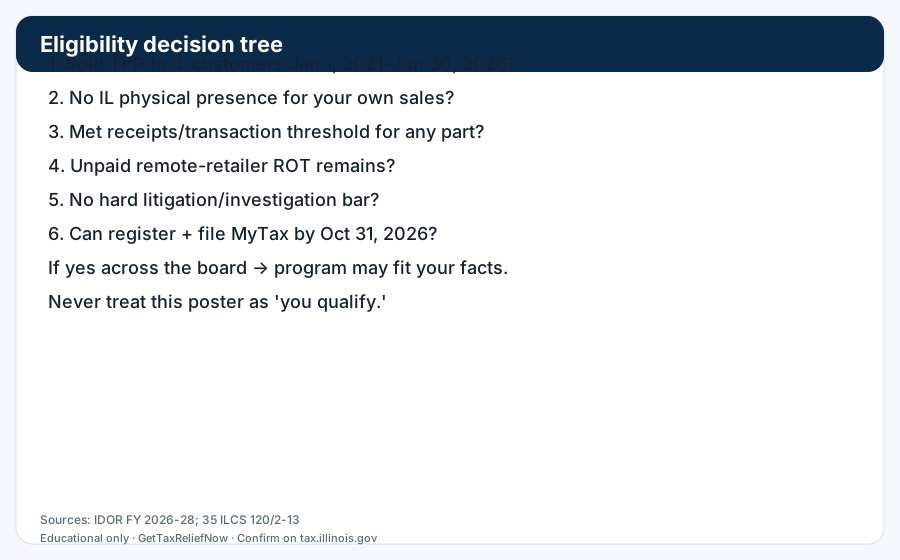
Based on IDOR FY 2026-28, the amnesty page, and 35 ILCS 120/2-13, a business may qualify if all of the following are true in substance:
- It is a remote retailer. It sells tangible personal property to Illinois customers and has no physical presence in Illinois.
- It met a tax remittance threshold for all or part of the eligibility period under the rules that applied for the relevant quarters (receipts and/or transactions before 2026; receipts only for quarters beginning on or after January 1, 2026).
- It has unpaid sales tax for sales made between January 1, 2021, and June 30, 2026.
- It registers with IDOR (if not already registered) and has an active MyTax Illinois logon.
- It files electronically during the amnesty window using the Remote Retailer Amnesty Application.
- It pays eligible tax at the simplified rate (or the greater amount collected, if higher), either in full during the window or under an approved repayment plan that is successfully completed.
- It is not barred by a statutory exclusion (for example, certain pending litigation or criminal investigation, or fraud in the amnesty filing).
You are not required to claim every month from January 2021 through June 2026. IDOR states you may seek amnesty for certain months, years, or multiple ranges if tax was already remitted correctly for some periods, or if a threshold was not met for some periods.
Eligible tax types and periods
Liabilities for the following, incurred on sales made between January 1, 2021, and June 30, 2026, are eligible under FY 2026-28:
- Retailers' Occupation Tax, including items that must be titled or registered with a state agency
- All locally imposed retailers' occupation taxes administered by IDOR, including the Chicago Home Rule Municipal Soft Drink Retailers' Occupation Tax
Official quote: program purpose
From IDOR's amnesty program page:
"This program helps remote retailers who may not have complete location records for past sales. It allows them to come into compliance with Illinois sales tax laws using a simplified application process and easy-to-use tax rates."
From FY 2026-28:
"The 2026 Illinois Remote Retailer Tax Amnesty Program runs from August 1, 2026, through October 31, 2026. It allows qualifying remote retailers to pay eligible sales tax liabilities with related penalties and interest waived."
From 35 ILCS 120/2-13(a), key defined terms include:
"Eligibility period" means the period from January 1, 2021 through June 30, 2026.
"Remote retailer amnesty period" means the period from August 1, 2026 through October 31, 2026...
"Simplified retailers' occupation tax rate" means ... (i) 9% ... or (ii) 1.75% ...
Who does not qualify (or is at high risk of exclusion)
Treat the following as red flags. Some are hard statutory bars. Others are practical mismatches.
Likely outside the remote-retailer design
- Sellers with Illinois physical presence (for example, an Illinois office, employees creating nexus, or Illinois inventory used for the seller's own sales)
- Businesses that never met a tax remittance threshold during the eligibility period and have no unpaid remote-retailer ROT to report
- Tax types other than remote-retailer Retailers' Occupation Tax under this program (income tax, withholding, and other acts are outside Section 2-13 amnesty)
Statutory or bulletin exclusions and non-waived items
- Tax already remitted before the amnesty period (amnesty is not a refund program for prior correct payments)
- Lien filing and lien release fees
- Books and records penalties
- Bad check penalties
- Collection agency service fees
- Penalty and interest on liabilities fully paid before amnesty or that do not qualify
- Various other penalties and fees not based on a tax liability, including certain audit penalties
- Taxpayers who are a party to any criminal investigation, or to any civil or criminal litigation pending in any Illinois circuit court, appellate court, or the Supreme Court, for nonpayment, delinquency, or fraud in relation to any State tax
- Taxpayers who commit fraud or intentional misrepresentation of a material fact in any document filed under the Program
- Paper-filed liability (paper returns do not qualify)
Process failures that destroy relief
- Missing the October 31, 2026 filing deadline
- Filing without registration or without a working MyTax logon
- Entering a repayment plan and then failing to complete it (IDOR recalculates without the simplified rate and without penalty/interest waiver)
- Underreporting liability and then needing edits after IDOR processes the application (IDOR warns the amnesty application liability cannot be edited after processing)
Marketplace-facilitator caution
Section 2-13 is written around remote retailers as defined in the Act. Marketplace facilitators operate under related but distinct rules. Do not assume a facilitator account automatically uses this exact amnesty application. Confirm registration type, tax account setup, and IDOR instructions for your exact role before filing.
Application period and tax periods covered
| Concept | Dates |
|---|---|
| Amnesty application and payment window | August 1, 2026 – October 31, 2026 |
| Sales / eligibility period | January 1, 2021 – June 30, 2026 |
| Plan request deadline | By October 31, 2026 |
| Interest on unpaid plan balances begins | November 1, 2026 |
| Plan ACH withdrawals begin | December 1, 2026 |
Keep the two clocks separate in your head:
- What sales are covered (2021 through mid-2026)
- When you must act (late summer and fall 2026)
Penalty relief
If you pay all eligible tax liabilities in full during the amnesty period, or you successfully complete an approved repayment plan, IDOR will waive related penalties.
The statute goes further on the compliance bargain. If the remote retailer satisfies the tax liability under the program terms, the Department shall abate and not seek to collect applicable interest or penalties on those eligible transactions, and shall not seek civil or criminal prosecution of the remote retailer for the period of time for which amnesty has been granted.
Please note: "related" and "applicable" matter. Not every fee is a related penalty. Lien fees, bad-check penalties, books-and-records penalties, collection-agency fees, and certain audit penalties are listed by IDOR as items that are not waived.
Interest relief
Related interest is also waived when payment conditions are met (full payment in the window or successful plan completion).
If you use a repayment plan:
- Interest begins to accrue on the eligible liability balance beginning November 1, 2026.
- That accrued interest is collected at the end of the plan through additional installment(s) not exceeding the monthly agreed installment amount.
In other words, the plan still carries a cost of delay after October, even though successful completion preserves amnesty treatment on the underlying eligible tax.
Payment requirements
Full pay option
- Pay electronically with the Remote Retailer Amnesty Application during August 1–October 31, 2026.
- Remit tax at the simplified rate, or if you collected a higher amount, remit the greater amount collected.
- Verified overpayments or credit memoranda on the account may be treated as qualified payment toward eligible tax liability.
Greater-of rule
From FY 2026-28:
"If tax was collected at a higher rate than the simplified tax rate, the greater amount of tax collected must be reported and paid."
From 35 ILCS 120/2-13(c)(3), the remote retailer shall remit tax at the simplified rate or, if tax was collected, in the amount collected, whichever is greater.
Exemptions and certificates
Under the statute, the remote retailer remits simplified-rate tax on gross receipts from sales of tangible personal property into Illinois unless it can produce a valid exemption number or certificate, resale certificate, or direct pay permit issued by the Department. Keep those documents.
Recordkeeping for the 1.75% rate
Participants must keep records of all sales for which the 1.75% rate applies. If records do not exist to justify the 1.75% rate, sales are presumed subject to the 9% general merchandise rate.
Simplified tax rates: how the math works
| Category | Simplified rate | What it covers under IDOR materials |
|---|---|---|
| General merchandise | 9% | Combined State tax and average local retailers' occupation tax rate |
| Qualifying reduced-rate items | 1.75% | Items normally subject to the 1% State rate, including food for off-site consumption, prescription and nonprescription medicines, drugs, and medical appliances. Statute (35 ILCS 120/2-13) ties the 1.75% basket to 1% State-rate property and off-premises food, and excludes alcoholic liquor taxable under the Liquor Control Act, food consisting of or infused with adult-use cannabis, soft drinks, and food prepared for immediate consumption from that food description. |
Important limitation on the 1.75% basket
IDOR's bulletin describes the 1.75% category in plain language. The statute is more precise. The simplified 1.75% rate applies to gross receipts from (A) tangible personal property subject to the 1% State rate under Section 2-10 and (B) food for human consumption to be consumed off the premises where sold, with express exclusions for alcoholic liquor taxable under Section 8-1 of the Liquor Control Act of 1934, food consisting of or infused with adult-use cannabis, soft drinks, and food prepared for immediate consumption. Keep product-level records. If support is missing, IDOR presumes the 9% general merchandise rate.
Note: The dollar examples below are illustrative only. They are not assessments, quotes, or determinations for any taxpayer.
Worked example A — general merchandise only (illustrative only)
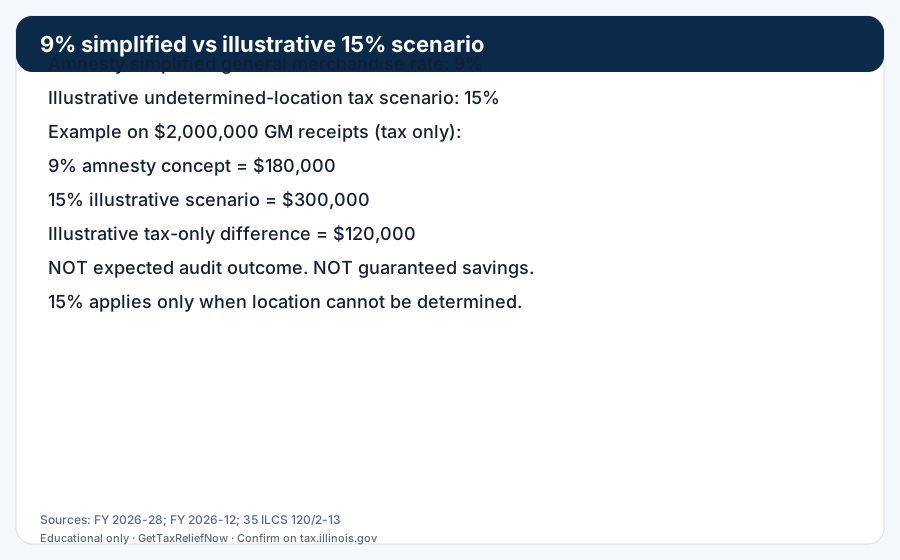
Facts: Out-of-state home-goods seller. No Illinois store or warehouse used for own sales. Illinois taxable remote sales of general merchandise from 2021 through mid-2026 with unpaid tax total $2,000,000 in gross receipts. No tax previously remitted. Records support general merchandise only.
Amnesty tax at 9%: $2,000,000 x 0.09 = $180,000
If paid in full by October 31, 2026, related penalties and interest are waived under program rules.
Contrast risk without amnesty: If destination locations cannot be proven in audit, IDOR may assess undetermined-location sales at 15%. On the same $2,000,000, 15% is $300,000 tax base assessment before ordinary penalties and interest — a $120,000 tax swing before add-ons.
Worked example B — mixed product mix with records (illustrative only)
Facts: Online pharmacy-adjacent retailer ships OTC medicines and general wellness goods. Valid records show $400,000 qualifying reduced-rate product receipts and $600,000 general merchandise receipts. No prior remittance.
- Reduced-rate tax: $400,000 x 0.0175 = $7,000
- General merchandise tax: $600,000 x 0.09 = $54,000
- Total amnesty tax: $61,000
If the business cannot substantiate the reduced-rate slice, IDOR presumption pushes that slice to 9%:
- All $1,000,000 at 9% = $90,000
- Documentation gap cost: $29,000
Worked example C — collected more than simplified rate (illustrative only)
Facts: Seller charged customers a blended 10.5% on $500,000 of general merchandise and held the money.
Simplified rate would be 9% x $500,000 = $45,000.
Amount collected = 10.5% x $500,000 = $52,500.
Amount to report and pay under greater-of rule: $52,500.
Worked example D — repayment plan (illustrative only)
Facts: Eligible simplified tax is $120,000. Business elects 24-month plan with required down payment (amount set in MyTax flow). Remaining balance is drafted monthly starting December 1, 2026. Interest accrues on the balance from November 1, 2026, and is collected at the end through extra installment(s) not above the monthly amount.
If the business defaults mid-plan, amnesty fails. Liability is rebuilt without simplified rates, and penalty/interest waiver is lost.
What businesses should do before applying
- Confirm remote-retailer status. Map physical presence: employees, offices, inventory, agents, and marketplace fulfillment patterns.
- Rebuild Illinois sales by period. Pull order, ship-to, SKU, and tax-collected data from January 1, 2021, through June 30, 2026.
- Run threshold tests by quarter. Apply the dual test through 2025 quarters and the receipts-only test for 2026 quarters.
- Separate marketplace-facilitated sales from direct sales. Do not double-count tax the facilitator already remitted, and do not ignore your own-site sales.
- Identify amounts already remitted. Amnesty is not for tax previously paid.
- Split receipts between 9% and 1.75% baskets only if records support the reduced-rate category.
- Compute greater-of collected versus simplified.
- Register early on MyTax Illinois if unregistered. Budget one to two business days, plus logon activation time.
- Open or restore the ST-1 account correctly as a remote retailer. If the amnesty application does not appear, contact Central Registration Division.
- Decide full pay versus plan. Stress-test cash flow before choosing 6/12/18/24 months.
- If under audit, contact your IDOR auditor before filing for guidance on amnesty-eligible liabilities.
- If closed or inactive, ask CRD how to reopen the sales tax account, file, then close only after application status shows completed.
- Preserve workpapers. Keep invoices, exemption certificates, rate support, and the amnesty submission package.
- Plan post-amnesty compliance. July 2026 ST-1 (due August 20, 2026) and later periods still matter.
How this affects marketplace sellers & marketplace vs direct sales
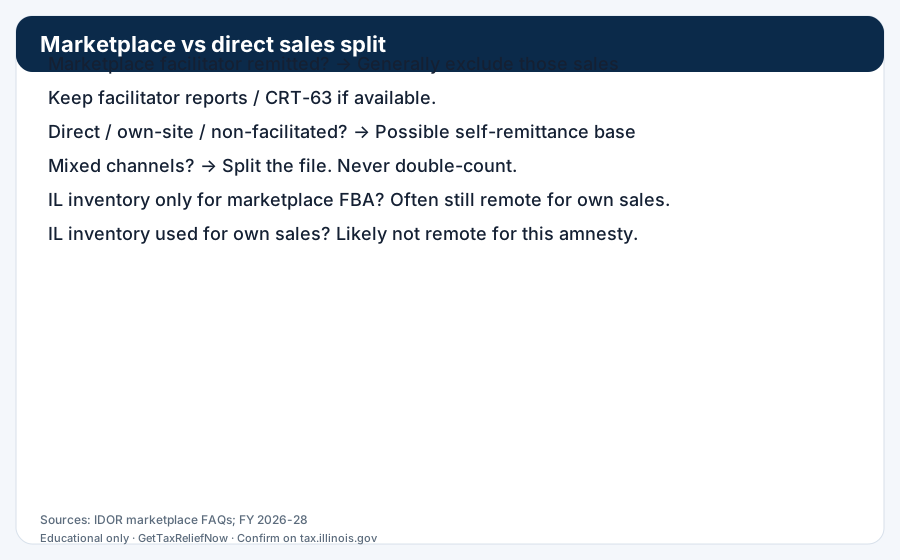
Marketplace sellers should split their world in two:
- Sales already tax-remitted by a marketplace facilitator. Those are generally the facilitator's remittance responsibility when facilitator rules apply. Do not casually "amnesty" tax someone else already paid.
- Direct or non-facilitated sales. Own website, phone orders, or channels where you are the retailer may create separate remote-retailer duties.
Also re-check physical presence. Fulfillment inventory in Illinois used only for marketplace orders is treated differently from inventory used for your own sales. If your own sales are fulfilled from Illinois inventory, you may not be a remote retailer.
Payment plan options
For general Illinois installment concepts outside this amnesty program, see the Illinois payment plan guide. Inside amnesty, use only the Remote Retailer Amnesty Application plan path in MyTax.
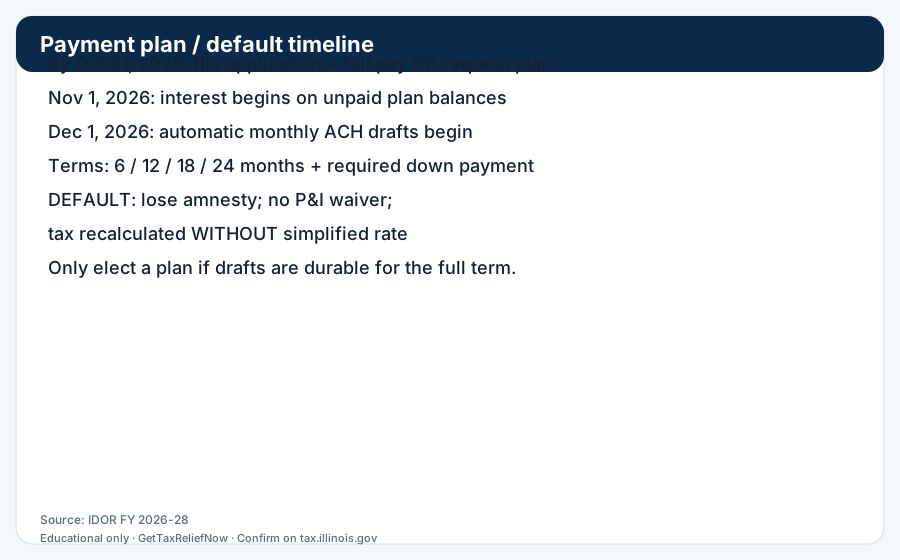
If you cannot pay in full because of financial hardship, you may request a repayment plan by October 31, 2026.
Hard rules from FY 2026-28
- Maximum term: 24 months
- Selectable terms: 6, 12, 18, or 24 months
- Payment method selection: choose "Payment Plan" on the Remote Retailer Amnesty Application
- Required data: bank routing and account numbers; number of installments; a down payment with the application
- Authorization: IDOR automatically withdraws monthly installments beginning December 1, 2026
- Failure consequences: you will not qualify for amnesty; penalty and interest will not be waived; tax liability will be recalculated under the Retailers' Occupation Tax Act without the benefit of the simplified rate
Decision note for cash-flow planning
A plan can preserve amnesty when cash is tight. A broken plan can be worse than never entering amnesty, because you may lose both the simplified rate and the penalty/interest waiver. Do not pick 24 months unless the monthly draft is durable.
Application process (step by step)
A. Register (if needed)
IDOR's amnesty page provides limited-time registration instructions, including:
- Register at mytax.illinois.gov using Register a New Business (Form REG-1).
- Identify Primary Business Activity as Retail and select Primary Business Type.
- On industries, select Yes under Product Sales or Services.
- On Sales and Use, select Yes under Merchandise, select Retail, and enter the date within the amnesty period that business activities began.
- On Merchandise or Services, select Yes to "Are you located outside Illinois?"
- On Outside of Illinois Questions, select Yes to both:
- conducting business in Illinois as a remote retailer or serviceman that meets the $100,000 threshold, and
- making $100,000 or more in annual sales to Illinois purchasers.
- On Changing Locations, select at least one location.
- Complete remaining steps and submit.
- Watch for IDOR email with account numbers and MyTax activation instructions.
- Create the MyTax Illinois logon (Sign Up flow; select taxpayer ID type).
CRD help: 217-785-3707; rev.crd@illinois.gov
B. File the Remote Retailer Amnesty Application
From FY 2026-28:
- Log in to MyTax Illinois.
- Next to your ST-1 Sales/Use Tax Account, select "View more account options."
- Under Account Options, select "Remote Retailer Amnesty Application."
- Follow the steps to complete the application.
- Indicate the periods from January 1, 2021, through June 30, 2026, for which you are claiming amnesty.
- Review records so the correct liability is reported. The amnesty application liability cannot be edited after it has been processed by IDOR.
C. Pay or elect a plan
- Pay in full electronically with the application, or
- Select Payment Plan, provide bank data, choose term, submit down payment, and authorize drafts.
D. After filing
- Save confirmations.
- Calendar draft dates if on a plan.
- Begin or continue ordinary ST-1 filing for current periods.
- If leaving Illinois markets permanently, request account closure only after application status is completed.
Required documentation and records to gather
Build a due-diligence file before you click submit:
- Entity formation documents and FEIN
- Illinois registration notice / account numbers
- Sales journals by month for Jan 2021–Jun 2026
- Ship-to state filters for Illinois
- Marketplace reports versus direct-channel reports
- SKU maps for food, drugs, medicines, medical appliances versus general merchandise
- Tax collected by invoice
- Exemption, resale, and direct-pay certificates
- Prior Illinois returns and payment proofs
- Credit memoranda / verified overpayments
- Bank information for plans
- Audit correspondence, if any
- Power of attorney (Form IL-2848) if a representative will handle the account
Statute and bulletin both emphasize retention. Participants remain subject to IDOR audit. Records of eligible transactions should include purchaser, purchase amount, taxes collected, and tax remitted. Reduced-rate sales need extra support.
Decision graphics
How amnesty compares to Voluntary Disclosure
| Feature | Remote Retailer Amnesty (2026) | Illinois Voluntary Disclosure Program |
|---|---|---|
| Core form / path | Remote Retailer Amnesty Application in MyTax | Form BOA-2 to Problems Resolution / VDP process |
| Who it targets | Remote retailers with eligible ROT | Broader noncompliant businesses and individuals (program rules apply) |
| Window | Aug 1–Oct 31, 2026 only | Ongoing program (not a short calendar amnesty) |
| Look-back / periods | Eligibility period Jan 1, 2021–Jun 30, 2026 for eligible transactions | Generally limits look-back to four years if requirements met |
| Tax rate mechanics | Simplified 9% / 1.75% statewide totals | Ordinary tax computation for disclosed liabilities |
| Penalties | Related penalties waived if conditions met | Penalties eliminated if tax and interest paid within 60 days of billing |
| Interest | Related interest waived if conditions met; plan interest accrues after Nov 1, 2026 | Interest remains due |
| Payment timing | Full pay in window or approved plan up to 24 months | Returns/payment timelines after approval (30 days, possible 60-day extension; interest/remaining tax within 60 days of notice) |
| Prior audit | Contact auditor; amnesty may still be discussed for qualifying remote-retailer liabilities | Common disqualification if IDOR already initiated audit/investigation before BOA-2 |
| Best use case | Remote sellers with weak destination location data and unpaid 2021–mid-2026 ROT | Broader clean-up when amnesty does not fit, or outside the amnesty window/types |
Advantages of amnesty (when you fit)
- Interest waiver on eligible paid tax (major cash difference versus VDP)
- Simplified rates and simplified reporting
- No purchaser-location detail required on the amnesty return
- Statutory non-prosecution language for the amnesty-covered period when conditions are met
- Protection from local government audit/review under the Local Government Revenue Recapture Act for program participants (per statute)
- Structured short-term payment plans inside the program
Disadvantages and risks of amnesty
- Short deadline
- Remote-retailer and ROT scope only
- Simplified rate may be higher than some true destination rates
- Greater-of collected rule can raise the bill
- Application liability not editable after processing
- Plan default unwinds simplified rate and waiver
- Not a cure-all for other tax types or non-waived fees
- Still subject to IDOR audit
Advantages of VDP
- Available outside the August–October 2026 window
- Four-year look-back limit when rules are met
- Penalty relief after timely tax and interest payment
- Useful when amnesty eligibility fails
Disadvantages of VDP versus this amnesty
- Interest generally still due
- No simplified remote-retailer rate package
- Tight post-approval filing and payment clocks
- Prior IDOR audit/investigation can disqualify
Official VDP: IDOR Voluntary Disclosure.