IRS Lien Risk & Release Calculator

Find out if the IRS can file a lien - and what to do next.
Liens attach to assets
Hurt credit & block financing
Can be avoided or removed

IRS Lien Risk & Release Calculator

See if the IRS Can File a Tax Lien Against You — And Whether It Can Be Removed

Most taxpayers don’t realize they’re exposed to an IRS tax lien until a real estate deal collapses, financing is blocked, or a credit report flags a public record. This IRS Lien Risk & Release Calculator helps you understand how your tax debt and unresolved tax liability may trigger enforcement by the Internal Revenue Service before collection actions escalate.

The calculator analyzes:

Your total tax debt and outstanding tax obligations
How long each tax period has remained unpaid after Notice and Demand
Whether required enforcement notices (such as Notice of Intent to Levy or Final Notice of Intent to Levy) have likely been issued
Your tax return filing status and overall tax filing compliance

Then it shows:

Your current IRS lien risk level
Whether a Notice of Federal Tax Lien or Tax Lien Filing may already be approaching
Which tax resolution services or payment options may still be realistic

Use the calculator now to understand your position before a lien becomes a public record attached to your real or personal property.

Step 1 of 4

Step 1 — IRS Federal Taxes

If you do not currently owe federal taxes, the calculator will stop.
Do you currently owe the IRS federal taxes?
Please select an option.
Next

Step 2 — Balance Amount

Enter your estimated total IRS balance owed.
Estimated total IRS balance owed
Must be greater than $0.
Please enter a valid amount greater than $0.

Step 3 — Notices & Assets

Select any IRS notices you’ve received and whether you own any assets.
Have you received IRS collection notices?
Select all that apply.
Please select an option.
Please select at least one option.
Do you currently own property or assets?
Select all that apply.
Please select at least one option.

Step 4 — Payment Plan & Lien Status

If required federal tax returns are not filed, the calculator will stop.
Are you in an active IRS payment plan?
Please select an option.
Has the IRS already filed a tax lien against you?
Please select an option.

NOT at risk at all

This is an estimate only and not legal or tax advice. IRS approval is not guaranteed.

Your IRS Tax Lien Risk Result

Risk tier, score, and confidence are based on your inputs.

-

-
Score: “Not sure” answers:
If any of this is inaccurate, go back and update your answers for a more reliable estimate.

What You Entered

Federal tax liens affect property and transactions, and timing matters when addressing them.

This checklist explains how lien filings work, what options may be available, and how to prevent further escalation once a lien issue is identified.
Download Emergency Checklist
This is an estimate only and not legal or tax advice. IRS approval is not guaranteed.
Important Disclosure
This calculator provides general informational estimates only and does not constitute tax, legal, or financial advice. Actual IRS decisions depend on documentation, compliance history, current rules, and your specific financial situation.
Take the Next Step
Use this calculator to understand your position before agreeing to any IRS action or payment arrangement. If results indicate risk, reviewing options early may help preserve flexibility.

What is a Tax Lien?

The IRS files a lien when you owe back taxes and don't pay.

Clipboard with IRS lien document and pen, surrounded by calculator, past due notices, stacks of hundred-dollar bills, and icons of a calendar, credit score, declining graph, and past due alert.

HOW THE CALCULATOR DETERMINES LIEN RISK

This calculator reflects how escalation actually works under tax law—not generic advice.

It evaluates

Common tax lien filing thresholds
Length of non-payment after formal Notice and Demand
Filing compliance (missing returns accelerate IRS lien enforcement)
Defaults on installment agreements or lump sum payment failures

WHAT AN IRS TAX LIEN MEANS (WHY RESULTS MATTER)

It evaluates

Federal tax liens are filed as a public record
They attach to real property, personal property, and after-acquired property.
They can block real estate transactions, refinancing, and access to bank accounts.
They establish priorities before more severe actions, such as tax levies or asset seizures.
Shield with green checkmark in center connected to icons of tax documents with calculator, a person at a desk, a payment plan document with pencil, and an envelope with money symbol.
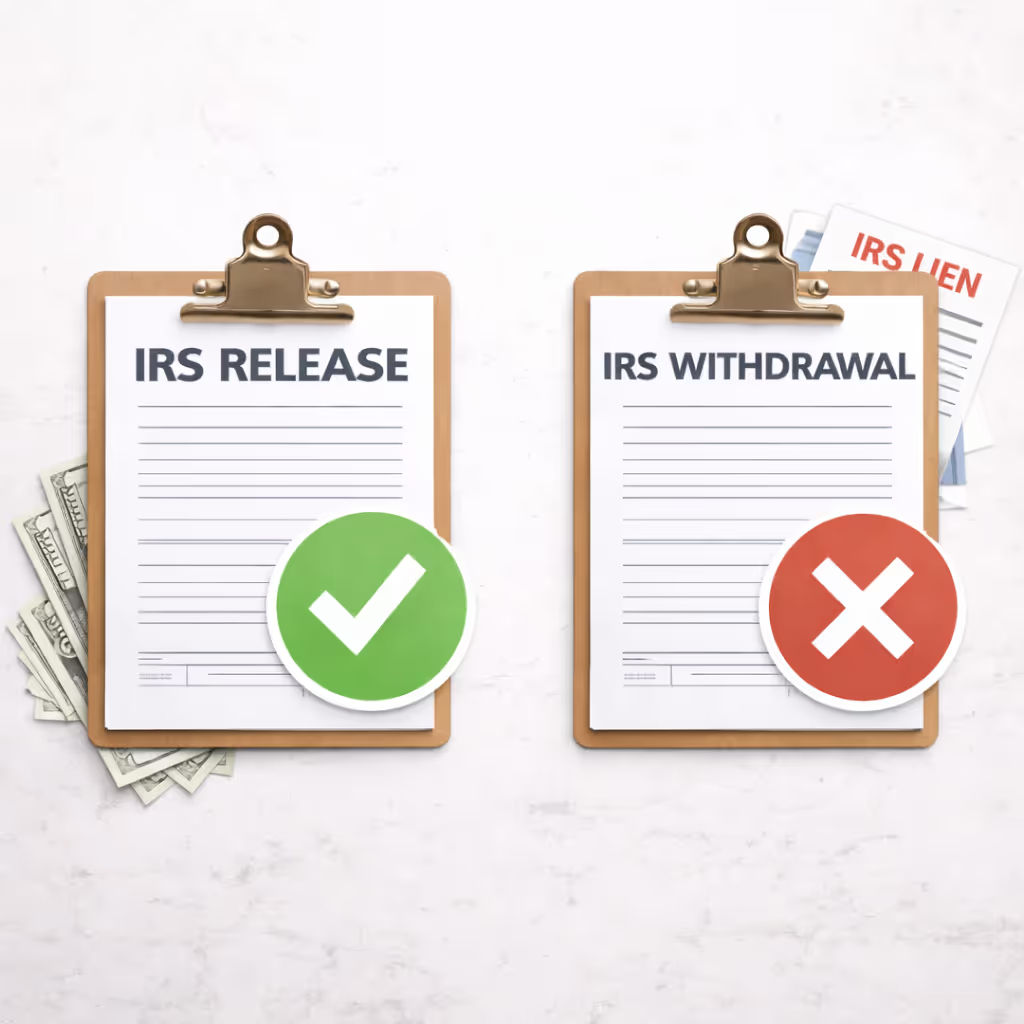
Two clipboards on a white surface, the left one labeled 'IRS RELEASE' with a green checkmark and cash peeking out, the right one labeled 'IRS WITHDRAWAL' with a red X and documents marked 'IRS LIEN' behind it.

CALCULATOR-MAPPED LIEN SOLUTIONS

Based on your inputs, the calculator may indicate whether options such as the following could still apply:

Withdrawal under the Fresh Start Initiative (best-case outcome when conditions allow)
Lien release after resolution or full payment
Lien subordination to allow financing or refinancing of real estate
Lien discharge to clear a specific transaction involving real or personal property

WHY USING THE CALCULATOR EARLY MATTERS

Most people seek help after enforcement has already occurred. At that point:

Options are narrower.
Leverage with law enforcement agencies and revenue officers is reduced.
Damage to credit reports, financing, and asset protection is harder to undo.
A torn paper labeled 'IRS LIEN' chained to icons representing a credit score meter, a house on fire, a wallet with money, and a calendar marked 'PAST DUE'.

Use the Calculator — Then Act

If the calculator shows moderate or high tax lien risk, delaying only helps the IRS.

A workspace with US dollar bills and coins, a calculator, eyeglasses, pens, legal documents, a clipboard with lined paper, and a wooden judge's gavel on a light marble surface.

Frequently Asked Questions (FAQs)

What does the IRS Lien Risk & Release Calculator actually do?
Can this calculator confirm whether a lien has already been filed?
Why does unpaid time increase lien risk so quickly?
Do missing returns really affect lien risk?
What should I do if my result shows moderate or high risk?
Are lien solutions guaranteed if I act early?
Is this calculator a substitute for professional advice?

Result sent!

Please check your email to review the result.
Oops! Something went wrong while submitting the form.

Result sent!

Please check your email to review the result.
Oops! Something went wrong while submitting the form.